Victorian Curriculum
VC2E5LA02
understand how to move beyond making bare assertions by taking account of differing ideas or opinions and authoritative sources
- recognising that a bare assertion (for example, ‘It's the best film this year.’) often needs to be tempered by using the ‘impersonal it’ to distance oneself (for example, ‘It could be said that it is the best film this year.’); recruiting anonymous support (for example, ‘It is generally agreed that it is the best film this year.’); indicating a general source of the opinion (for example, ‘Most critics agree that it is the best film this year.’); specifying the source of the opinion (for example, ‘Reviewers for The Reel Film stated that it is the best film this year.’) and reflecting on the effect of these different choices
Show more
3
teaching resources for those 'aha' moments
- Plus Plan

Comparing Assertions Worksheet Pack
Get your students to compare assertions with this engaging set of worksheets designed to help students distinguish between strong and weak persuasive writing.
- Plus Plan
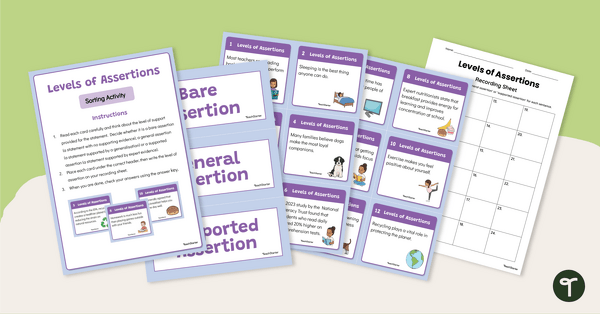
Types of Assertions Sorting Activity
Explore types of assertions with this interactive sorting activity that helps students distinguish between bare, generalised and supported assertions.
- Plus Plan
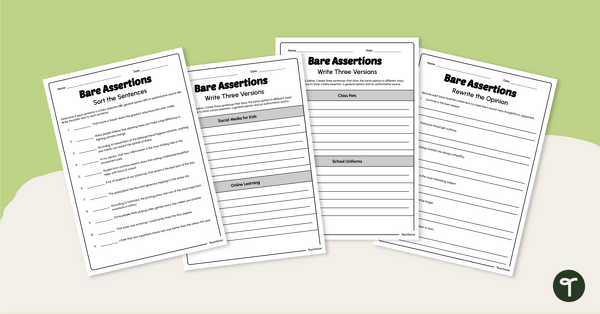
Bare Assertions Worksheet Pack
Strengthen student writing by helping them turn bare assertions into well-supported opinions using these engaging and practical worksheets.