ACELA1507
Understand the difference between main and subordinate clauses and that a complex sentence involves at least one subordinate clause
Elaborations
- knowing that complex sentences make connections between ideas, such as: to provide a reason, for example 'He jumped up because the bell rang.'; to state a purpose, for example 'She raced home to confront her brother.'; to express a condition, for example 'It will break if you push it.'; to make a concession, for example 'She went to work even though she was not feeling well.'; to link two ideas in terms of various time relations, for example 'Nero fiddled while Rome burned.' (Skills: Literacy, Critical and Creative Thinking)
- knowing that a complex sentence typically consists of a main clause and a subordinate clause (Skills: Literacy, Critical and Creative Thinking)
- Free Plan
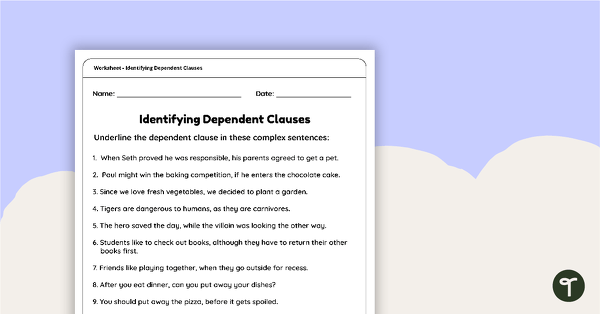
Identifying Dependent Clauses Worksheet
Practise identifying dependent clauses in complex sentences with a dependent clause worksheet.
- Plus Plan
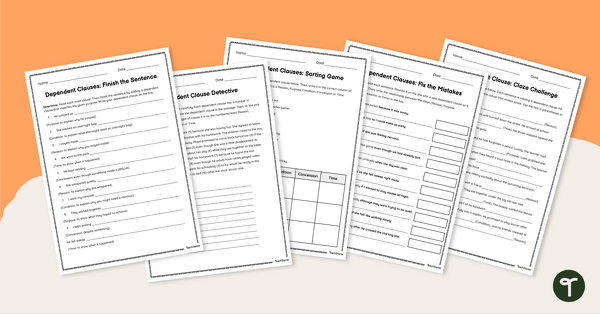
Dependent Clause Worksheets
Explore how a dependent clause can show purpose, time, reason, concession and condition with this engaging set of worksheets for Year 5 students.
- Plus Plan
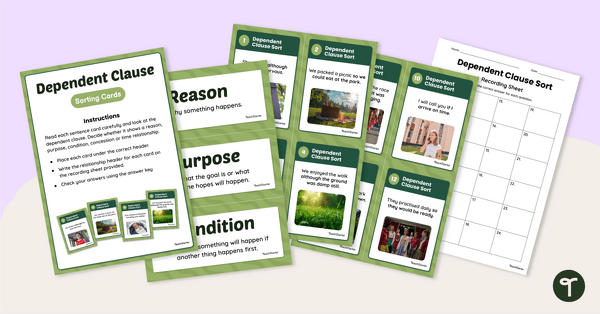
Types of Dependent Clauses Sorting Activity
Teach the types of dependent clauses with this hands-on sorting activity that helps students explore sentence structure in a collaborative and engaging way.
- Plus Plan
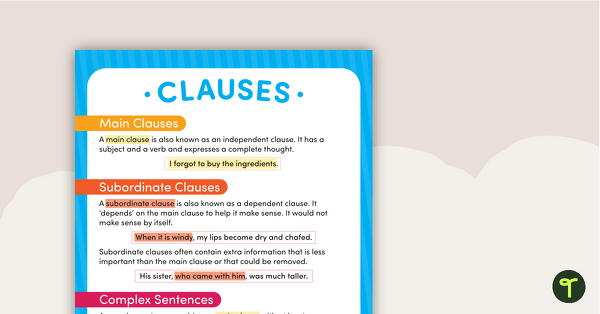
Main Clauses and Subordinate Clauses Poster
A poster explaining main clauses and subordinate clauses.
- Plus Plan
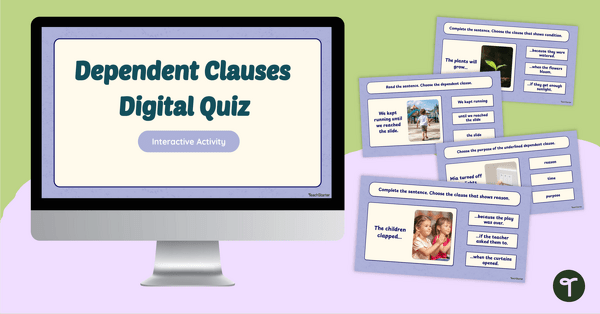
Dependent Clauses Digital Quiz
Explore dependent clauses with this interactive digital quiz that helps students identify clauses that show time, purpose, concession, condition and reason.