Measurement Conversions Teaching Resources
Teaching measurement conversions is about to get easier this school year! Explore units of measurement conversion worksheets, activities and more teacher resources created by Australian teachers for teachers like you.
This collection of digital and printable maths resources is aligned with the Australian maths curriculum (including version 9.0!), and each resource has been created specifically to help you build your lesson plans. Whether your primary students are still learning about the relationships between units of measurement or they're learning to convert between larger and smaller units within the same measurement system, we've got you covered!
Is this your first year teaching students how to convert measurements? Or maybe you're looking for some fresh ideas to make this maths concept more fun? Read on for a helpful primer from our teacher team with helpful tips to teach unit conversion!
What Is Unit Conversion in Maths? A Kid-Friendly Definition
Whether you call it 'unit conversion' or 'conversion of units' or 'units of measurement conversion,' this maths skill is crucial for students to learn to prepare them for the real world, where we face these questions every time we bake a cake or measure an item of furniture.
But what is a unit conversion, exactly? How do you explain it to your students?
Here's a handy definition that can help you do just that!
Unit conversion is a maths process in which we transform one unit of measurement to another unit of the same quantity.

Unit conversion involves different operations, depending on the units of measurement that are involved.
For example, let's say you have set up a rain gauge outside the school to measure how much rain falls during a particular time period. You might mark down the amount of rain in millilitres each day to track daily rainfall.
But what if you want to know the amount of total rain that fell over a whole month, and you want to calculate that total in liters?
You could add up all of the daily values in millilitres to determine the total volume of rain, however you still need to perform a unit conversion to find out what that represents in litres! To find that answer, you'll need to use the division operation.
If you collected 1134 millilitres of rainfall during the month of February, for example, finding the total volume in litres would require dividing the millilitre volume value by 1000. The result would be 1.134 litres.
Converting Units of Measurement in the Metric System (International System of Units)
The key to understanding how to convert units of measurement in the metric system is to understand the system itself and the meaning of the various prefixes.
Because the metric system is based on 10s, going from small units to larger units requires simple multiplication, while going from large units to small can be done with simple division.
For example, let's say you were going to run a 3 kilometre race, and you wanted to work out how many total metres you will have to run to reach the finish line.
Because 1 kilometre is equal to 1000 metres, you can easily find the answer with the help of multiplication — 3 x 1000 = 3000 metres.
Common Metric System Prefixes — A Handy Chart for Teachers
- Kilo- (k) — 1000 times the base unit.
- Hecto- (h) — 100 times the base unit.
- Deca- (da) — 10 times the base unit.
- Deci- (d) — One-tenth of the base unit.
- Centi- (c) — One-hundredth of the base unit.
- Milli- (m) — One-thousandth of the base unit.
- Plus Plan
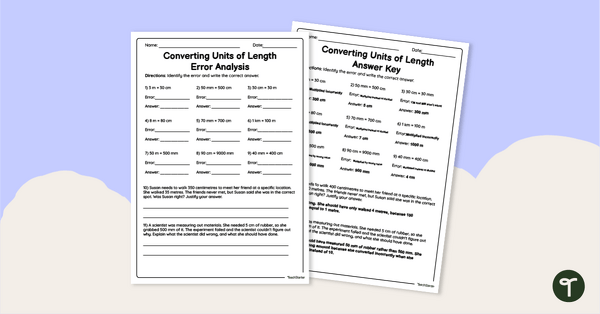
Converting Units of Length – Error Analysis Worksheet
Analyse length conversions to identify and correct mistakes with this error analysis worksheet.
- Plus Plan
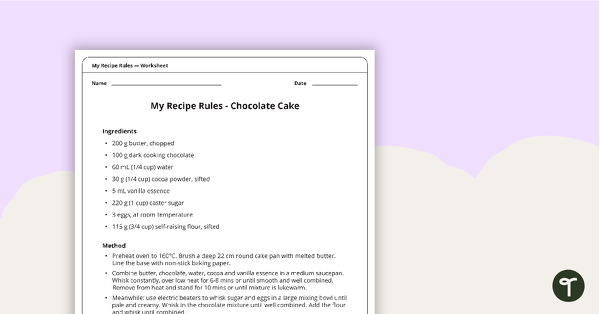
My Recipe Rules - Measurement Worksheet
A worksheet using money and measurement concepts.
- Plus Plan
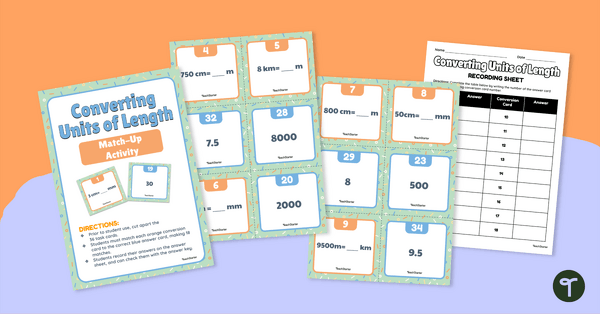
Measurement Conversion Games — Matching Lengths
Provide students with measurement conversion games like this matching activity to give them practice converting between common units of length.
- Plus Plan
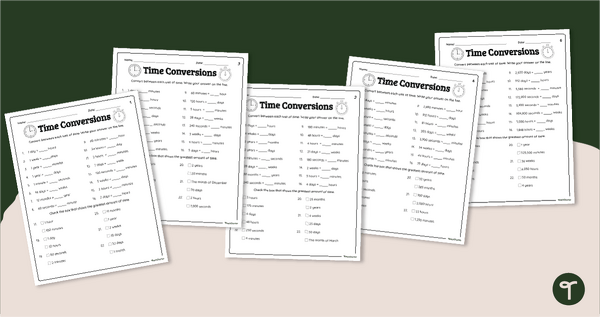
Converting Units of Time Test Pack
Assess your students’ abilities to convert units of time with a set of differentiated time conversion tests.
- Plus Plan
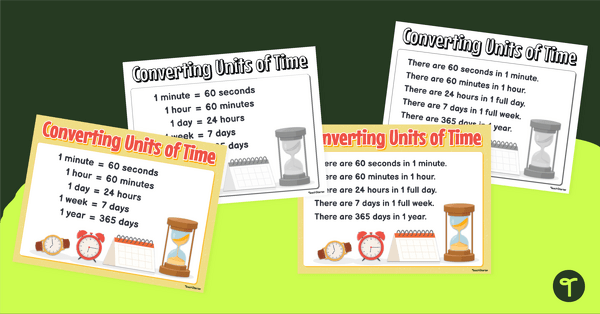
Time Conversion Chart - Year 4 Maths
Help your Year 4 Maths students learn to convert units of time with a printable Time Conversion Chart.
- Plus Plan
Converting Units of Measurement Poster (Imperial)
Use these posters to assist your students in learning the different units of measurement in the imperial system.
- Plus Plan
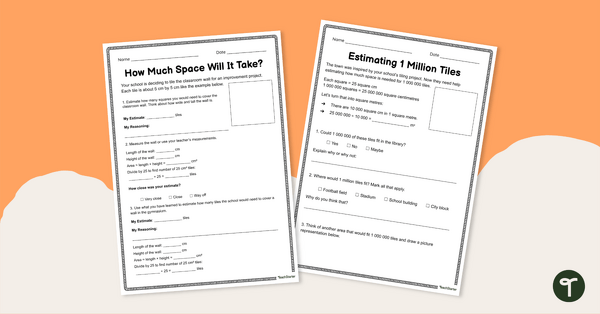
Estimation Activity - Estimating Space Worksheet Set
Use estimation activities like this estimating space worksheet set to give your students practice estimating, converting measurements and problem solving.
- Plus Plan
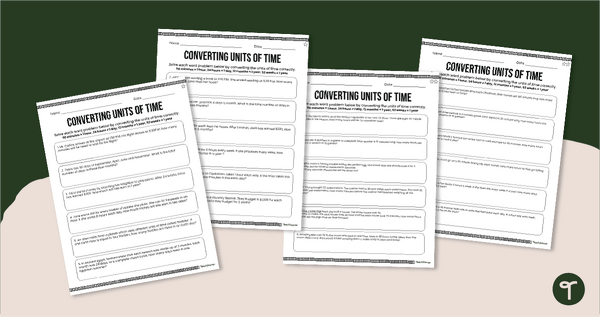
Converting Time Word Problems Worksheet
Develop problem solving skills set of printable multi-step time conversion worksheets.
- Plus Plan
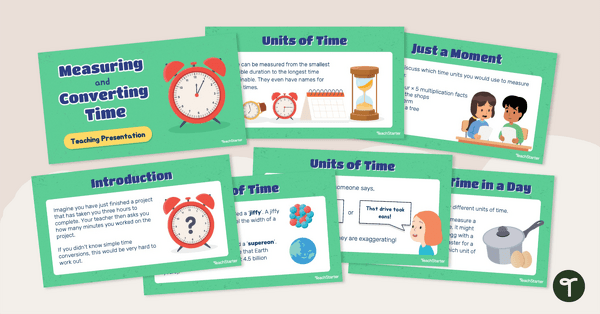
Measuring and Converting Time – Teaching Presentation
Learn how to measure and convert time with this 14-slide teaching presentation.
- Free Plan
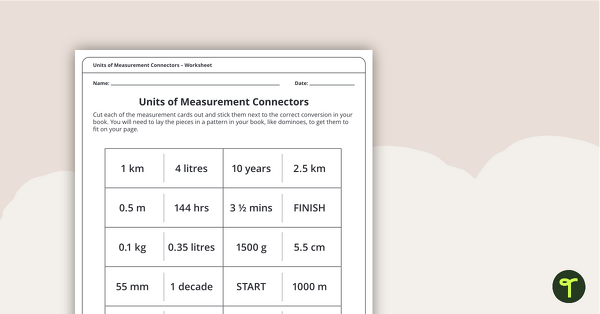
Metric Units of Measurement Connectors
A worksheet connecting units of measurement.
- Plus Plan
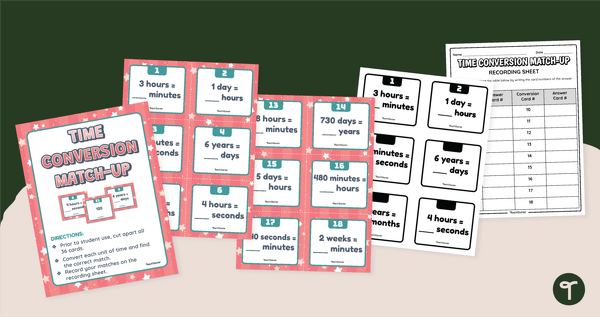
Time Unit Conversion Match-Up Game
Convert increments of time, including seconds, minutes, hours, days, weeks, and months, with a printable Time Conversion matching activity.
- Free Plan
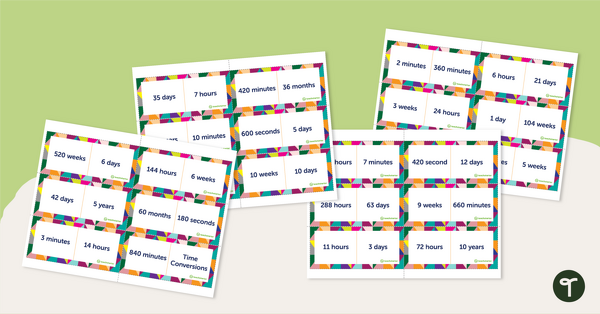
Time Unit Conversions Dominoes
Practise converting units of time with a fun game of Time Conversion Dominoes!