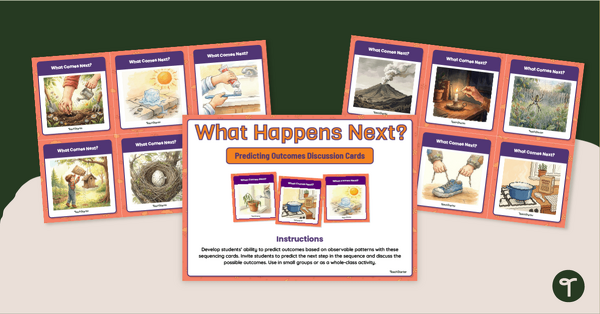
Introduce your students to scientific thinking and predicting steps in a sequence with printable Predicting Outcomes Activity Cards.
What Happens Next? Predicting and Sequencing Picture Cards for Early Learners
Help young students develop scientific thinking with these engaging “What Happens Next?” sequencing picture cards. Designed for early primary school learners, this resource supports students as they practise predicting outcomes by closely observing what they see and thinking about what might happen next.
These sequencing picture cards are ideal for developing early inquiry skills through world-based learning and engaging classroom discussions.
Observe & Predict Outcomes in Scientific Processes
These cards contain simple, kid-friendly illustrations of the first stages in a variety of familiar scientific processes, such as:
- Watering a seed
- Lighting a candle
- An egg cracking
- Water heating
Before revealing the outcome as a whole group, students are encouraged to discuss what they think will happen next and explain their reasoning. This supports the development of speaking skills, sequencing skills, cause-and-effect understanding, and early scientific reasoning.
Use these cards to spark:
- Oral language and discussion
- Prediction-making and reasoning
- Turn-and-talk moments
Guided science conversations
These printable picture cards are designed to be laminated for durability and reused.
Download and Use This Science Sequencing Activity
This low-prep Science Sequencing Activity offers a fun approach to introducing scientific prediction and sequencing skills in a meaningful and visual manner. Print, laminate, and you’ll have a ready-to-use science inquiry tool you can revisit again and again.
This resource is available in both PDF and editable Google Slides format. To get your copy, click the dropdown arrow on the download button and choose your preferred file type.
This resource was created by Lindsey Phillips, a teacher and Teach Starter Collaborator.
More Early Years’ Science Inquiry Activities
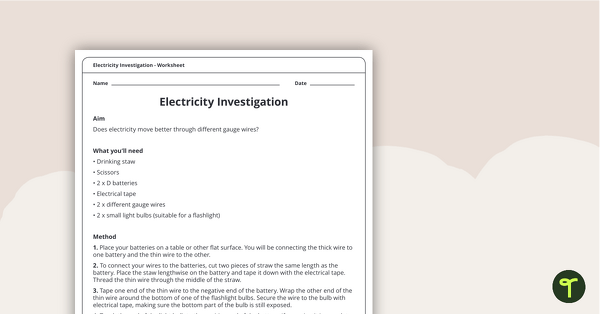
Pair these sequencing cards with more of our early years’ science inquiry activities to continue building strong science inquiry habits in your F-2 classroom. Make sure you check these out before you go!
[resource:5182047] [resource:5178520] [resource:1971154]




0 Comments
Write a review to help other teachers and parents like yourself. If you'd like to request a change to this resource, or report an error, select the corresponding tab above.