ACELA1520
Understand that cohesive links can be made in texts by omitting or replacing words
Elaborations
- noting how a general word is often used for a more specific word already mentioned, for example ‘Look at those apples. Can I have one?' (Skills: Literacy)
- recognising how cohesion can be developed through repeating key words or by using synonyms or antonyms (Skills: Literacy, Critical and Creative Thinking)
- observing how relationships between concepts can be represented visually through similarity, contrast, juxtaposition, repetition, class-subclass diagrams, part-whole diagrams, cause-and-effect figures, visual continuities and discontinuities (Skills: Literacy, Critical and Creative Thinking)
- Plus Plan
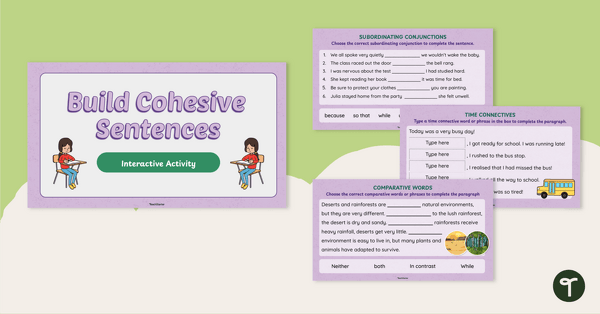
Cohesive Sentence Interactive Activity
Engage students with interactive slides that teach the features of a cohesive sentence through a variety of hands-on activities.
- Plus Plan
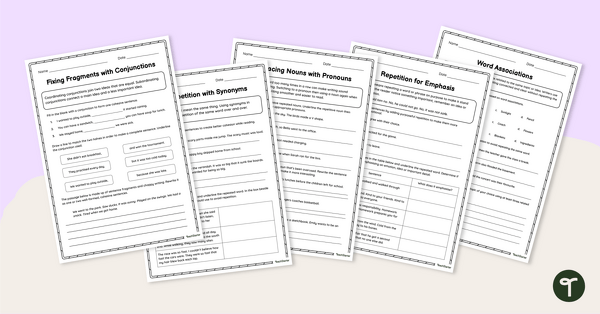
Sentence Cohesion Worksheet Pack
Use this sentence cohesion worksheet pack to teach your students about how to write clear sentences containing strongly connected ideas.
- Plus Plan
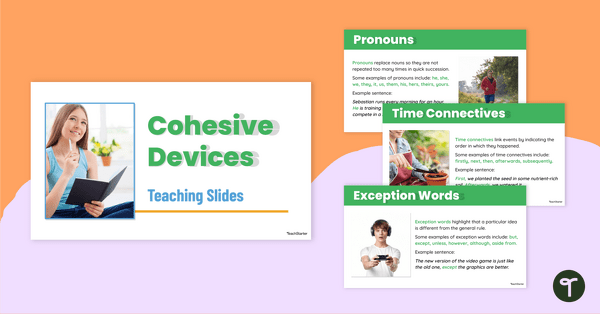
Cohesive Devices Teaching Slides
Explore cohesive devices with this engaging teaching slide deck designed to help primary students understand and use them confidently in their writing.
- Plus Plan
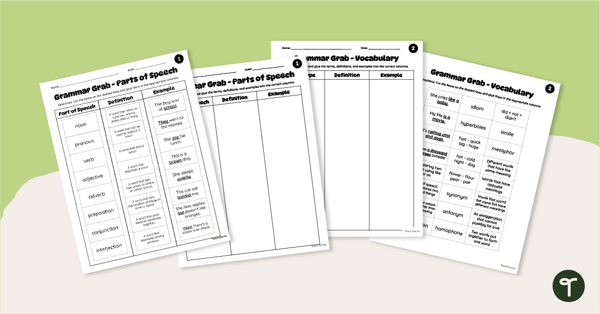
Grammar Practice Worksheets - Vocabulary Cut and Sort
Review parts of speech and vocabulary skills with a pack of cut-and-paste grammar practice worksheets.
- Plus Plan
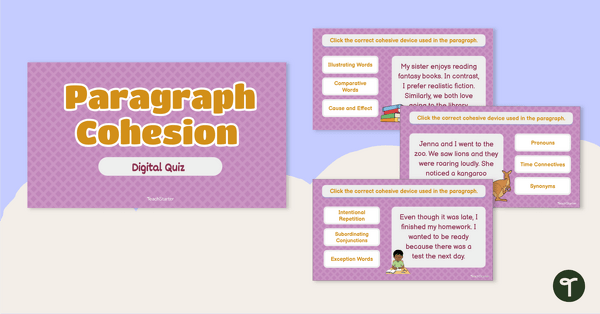
Cohesive Paragraph Digital Quiz
Explore what makes a cohesive paragraph using this interactive digital quiz that helps students identify cohesive devices in context.
- Plus Plan
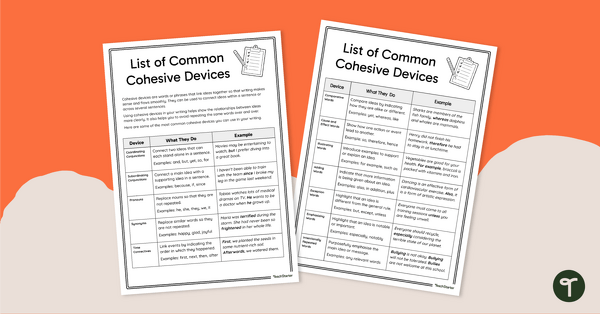
Cohesive Devices List
Download this cohesive devices list for your students to refer to when writing a variety of text types.