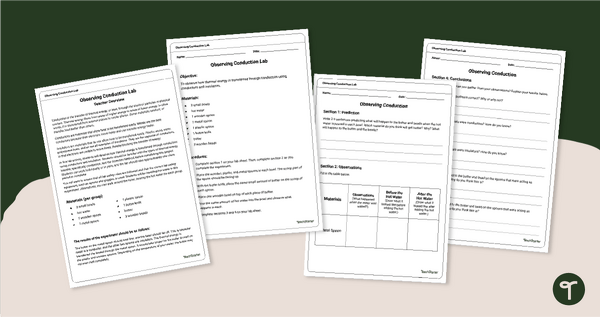
Teach students to make predictions about and observe thermal energy transfer through this conduction experiment.
The heat is on!
In this simple thermal energy experiment, students will explore the process of conduction and insulation by observing the transfer of heat energy between household items.
Observe Heat Transfer With a Thermal Conduction Experiment
Conductors (like metal) are materials that let electrons move freely and thus allow heat to be transferred easily. Insulators (like wood) are materials that do not allow electrons to move freely and therefore block the transfer of heat. This Thermal Conduction Experiment allows students to get hands-on in a safe environment to watch the process of conduction and insulation using 3 materials:
- Metal
- Wood
- Plastic
In this Thermal Conduction Experiment, students will use warm water to heat up the materials, and armed with their knowledge of the Scientific Method, determine which material conducts heat best.
What You Will Need
The best way to use this activity is in science class as students work individually or in pairs. However, it can also be assigned as homework with parental supervision. Each student or group of students should have their own copy of this resource as they work on the heat transfer activity.
To perform this experiment with your students, each group will need the following supplies:
- 3 small bowls
- hot water
- 1 wooden spoon
- 1 metal spoon
- 1 plastic spoon
- 1 butter knife
- butter
- 3 wooden beads
Students will observe how easily the wood beads fall off the spoons as the butter melts as a reaction to the heat transfer from the water to the metal, wood, and plastic spoons. They’ll be able to identify which of the spoons acts as a conductor and which acts as an insulator.
Take The Thermal Energy Experiment Further
Students can choose three other objects to experiment on and predict which would be the better thermal conductor.
For students who are struggling to understand the concept, it may be helpful to display different examples of conductors and insulators on the board and review what each is before starting the activity.
Before You Download
Use the drop-down menu to choose between the Google Doc or Google Slides version.
This resource was created by Gabriela Perez, a teacher and Teach Starter Collaborator.
Looking for more great science activities to use in the classroom? Your students are going to love these:
teaching resource
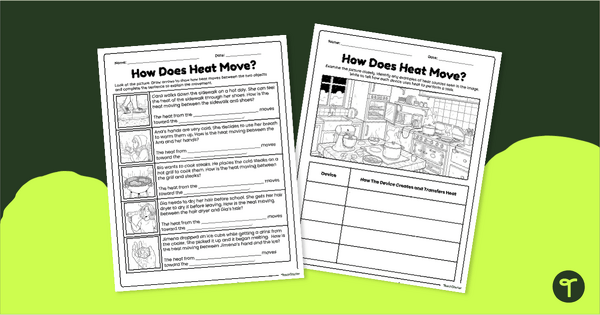
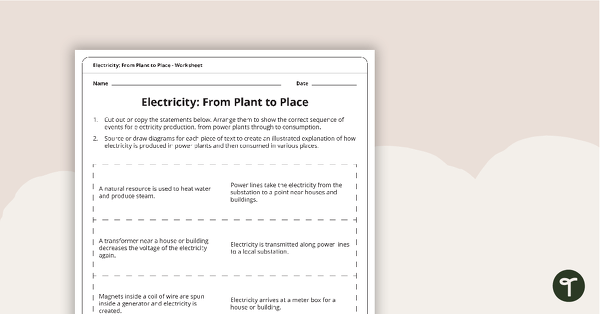
How Does Heat Move? Heat Transfer Worksheet
Explore heat transfer and sources of heat with our "How Does Heat Move?" Heat Transfer Worksheet.
teaching resource
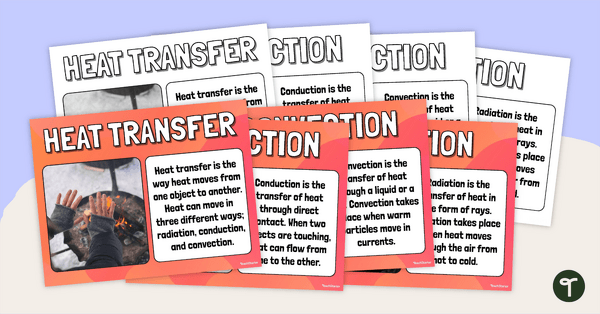
Heat Transfer Posters
Display these posters to check understanding or reinforce the teaching and learning of how heat energy transfers.
teaching resource
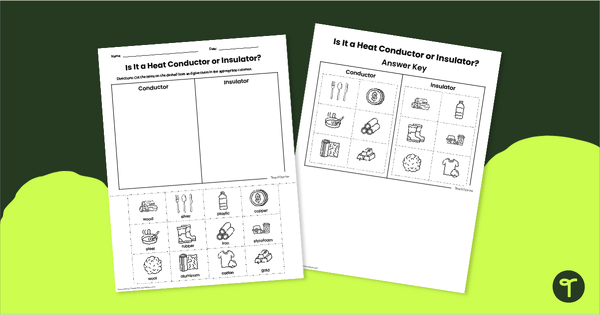
Thermal Conductor or Insulator? Worksheet
With this hands-on Thermal Conductor or Insulator Worksheet, students will cut and sort conductors and insulators.





0 Comments
Write a review to help other teachers and parents like yourself. If you'd like to request a change to this resource, or report an error, select the corresponding tab above.