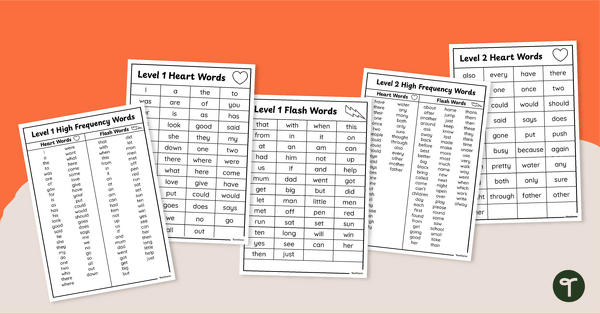
Use this set of leveled high frequency word lists which are a collection of the most commonly used words divided into heart words and flash words for teaching purposes.
High Frequency Word Lists for Kinder and 1st Grade: Heart Words + Flash Words
This resource provides a clear, easy‑to‑use collection of words organized into Kinder and 1st Grade lists suitable for Prep and Year 1, further divided into Heart Words (words with tricky or irregular parts) and Flash Words (fully decodable words designed for quick recall). It’s designed to support early readers as they build strong foundations in phonics, decoding, and high‑frequency word recognition, while giving teachers a practical tool they can use every day.
These high‑frequency word lists are designed to support explicit teaching, not to encourage students to memorize long lists of words by sight. The goal is to help teachers show children how words work, where the sounds are predictable, where the tricky parts are, and how letters map to sounds.
Why the Teaching of Learning High Frequency Words Matter
High‑frequency words are simply the words students encounter most often in early texts, words like the, is, to, at, in, and more. For years, these words were traditionally memorized as whole words because many were considered “irregular” or too difficult for beginning readers to decode. Teachers often used flashcards, rote recall, or long lists of sight words that students were expected to learn by visual memory alone.
The Science of Reading, however, has shifted our understanding of how children actually learn words. Rather than memorizing them as entire shapes, students build word recognition through orthographic mapping, the mental process of connecting letters to sounds and mapping them permanently to memory. Research now shows that even high‑frequency words can usually be decoded once students understand the predictable and “tricky” parts.
This is why best practice now encourages dividing lists into:
- Flash Words – fully decodable words that follow phonics patterns students have been taught
- Heart Words – words that are mostly decodable except for one tricky part that students learn “by heart.”
Sometimes words can be mixed between the two depending on the skill level of the student being taught the words.
Download these Free High Frequency Word Lists Today!
Use the dropdown menu to download these free High Frequency Word lists, the PDF will provide you with an easy to print document, while the Google Slides provides you with an editable version – where you can change words around on each list based on your students’ abilities – or perhaps the lists your school uses.
This resource was created by Lindsey Phillips, a teacher in Michigan and Teach Starter Collaborator.
More High Frequency Word Resources
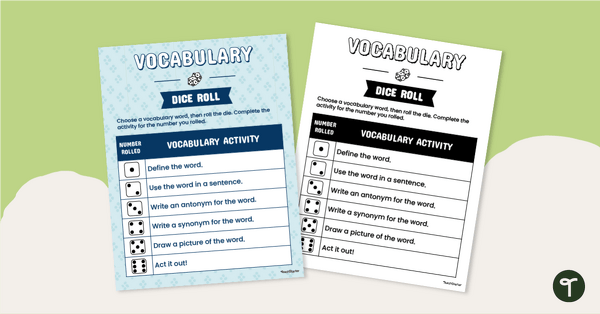
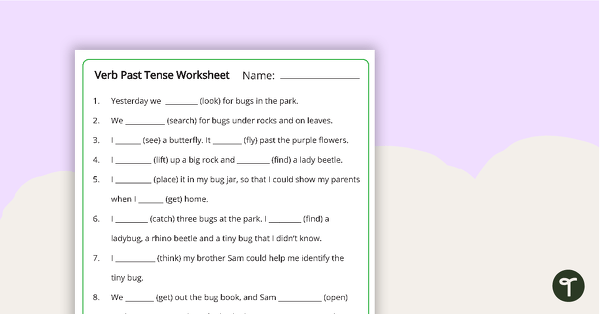
Looking for more high frequency word resources to use in the classroom? We have you covered…
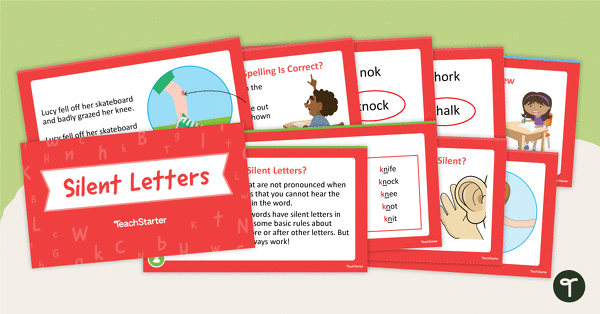
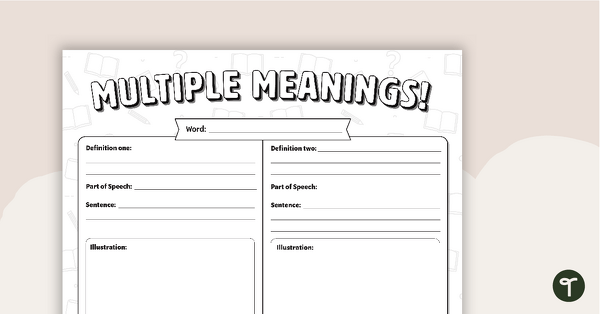
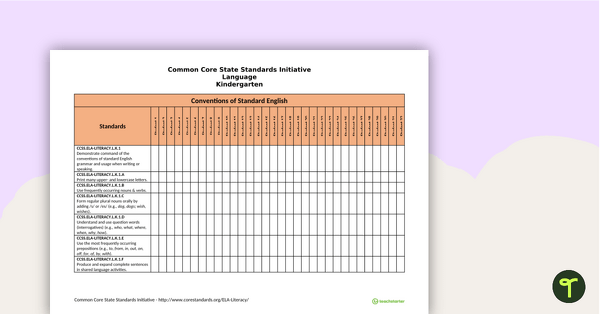
[resource:4953743] [resource:5195665] [resource:4604160]

0 Comments
Write a review to help other teachers and parents like yourself. If you'd like to request a change to this resource, or report an error, select the corresponding tab above.