Decimals Teaching Resources
Browse decimal worksheets, games and more Australian curriculum V9 resources created by primary teachers for your primary classroom!
Explore editable resources you can easily differentiate for individual learners plus maths rotations activities and engaging games to help students learn how to read and write decimals using place value and the decimal point, how to convert a decimal to a fraction and more.
What Are Decimals? A Kid-Friendly Definition
Explaining decimals to your class? Here's a kid-friendly definition that will help!
A decimal is a special way to write parts of a whole number. Decimals are a lot like fractions, but instead of using numbers like 1/2 or 1/4, we use a dot called a decimal point to separate the whole number part from the part that is less than one.
The number before the decimal tells you how many wholes you have, and the digits after the decimal point tell you how many groups of one-tenth, one-hundredth or one-thousandth you have.
One of the most common places students will encounter decimals in real life is when using money — a dollar is a whole number, while cents are a part of the whole and are typically represented beyond a decimal point.
How Do You Turn a Decimal Into a Fraction and Vice Versa?
Turning decimals into fractions and doing the reverse are both important skills for students to develop. Here are simple processes for doing just that!
How to Turn a Decimal Into a Fraction
- Write down the digits in the decimal over its place value.
- For example, if you have the decimal 0.75 (seventy-five hundredths), you would write it as 75/100.
- Simplify the fraction by finding the greatest common factor (GCF) of the numerator and denominator and dividing both by it.
- In the example above, the GCF of 75 and 100 is 25, so dividing both by 25 gives you the simplified fraction 3/4. This means 0.75 as a fraction is 3/4.

How to Turn a Fraction Into a Decimal
To turn a fraction into a decimal, your students will need to divide the numerator (top number) by the denominator (bottom number).
- Divide the numerator by the denominator.
- If the numerator does not divide evenly by the denominator, add zeroes to the dividend to continue the division to as many decimal places as needed or desired. Don't forget to add a decimal point after the digit found in the denominator!
- Round the decimal to the desired number of decimal places, if necessary.
How Do You Round Decimals?
Another skill students need to learn is the process of rounding decimals to the nearest whole number or to a specific decimal place. This will allow your students to simplify numbers, making them easier to work with!
This will be useful when doing things such as rounding to the nearest dollar amount when working with money.
Rounding can also be used to get a general sense of a number without worrying about the exact value, which can be helpful in certain situations, such as estimating a budget or measurement.
To round a decimal to the nearest whole number, you need to look at the digit to the right of the decimal point.
- If that digit is 5 or greater, you round up to the next whole number.
- If that digit is 4 or less, you round down to the current whole number.
For example, let's say you want to round the decimal 3.7 to the nearest whole number. The digit to the right of the decimal point is 7, which is 5 or greater, so you round up to 4.
- Plus Plan
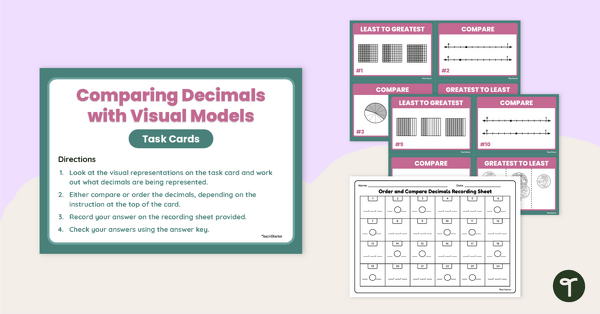
Comparing Decimals with Visual Models Task Cards
Get students comparing and ordering decimals using visual models with this set of 24 task cards perfect for maths rotations.
- Plus Plan
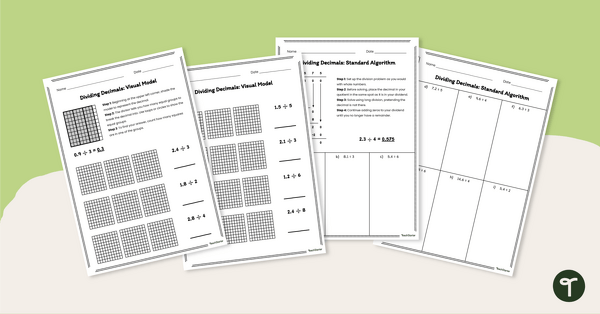
Dividing Decimals by Whole Numbers Worksheet Pack
Download these dividing decimals by whole numbers worksheets to provide your students with practice using visual models and the standard algorithm.
- Plus Plan
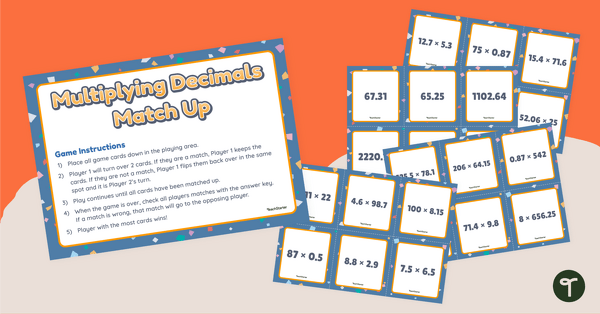
Multiplying Decimals Match-Up Activity
Get students multiplying decimals with this engaging card game, perfect for maths groups.
- Plus Plan
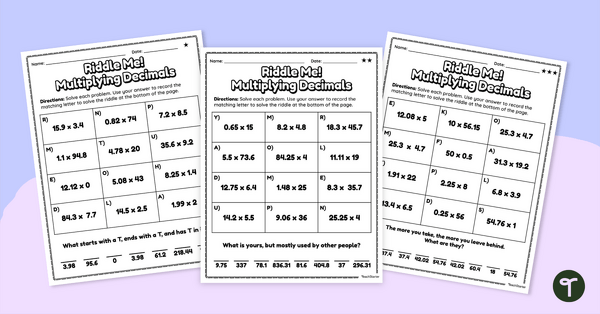
Multiplying Decimals – Riddle Worksheets
Get students solving decimal multiplication problems with this set of 3 differentiated riddle worksheets.
- Free Plan
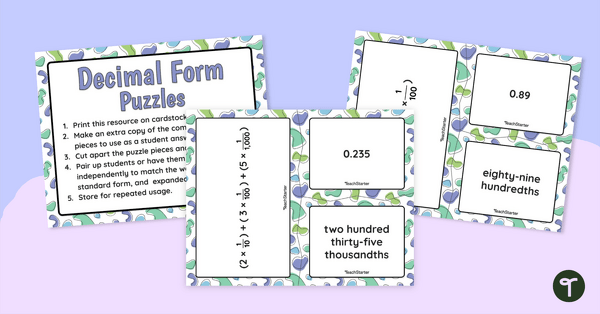
Decimal Notation Puzzles
Practice expanded notation, word form and standard form using decimals with this set of 13 three-piece puzzles.
- Plus Plan
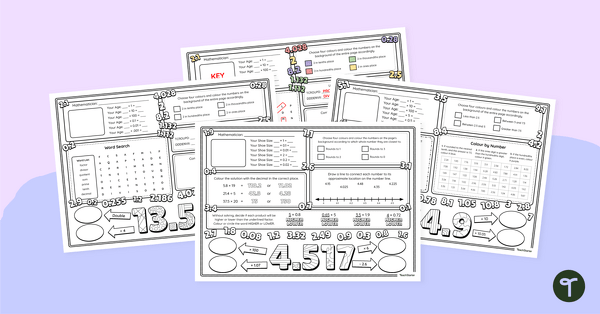
Decimal Operations Maths Mats
Get students reviewing decimal operations with these engaging, puzzle-based math mats.
- Plus Plan
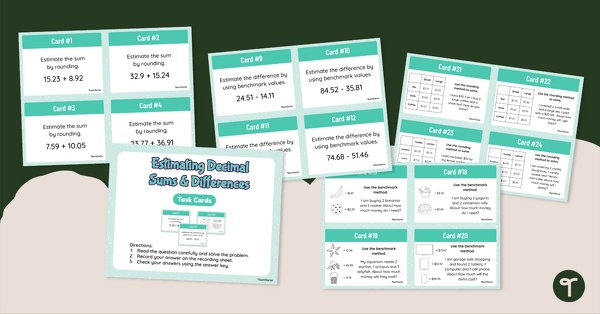
Estimating Decimal Sums and Differences Task Cards
Challenge your students to use rounding and benchmark values to estimate sums and differences of decimals with this set of 24 task cards.
- Plus Plan
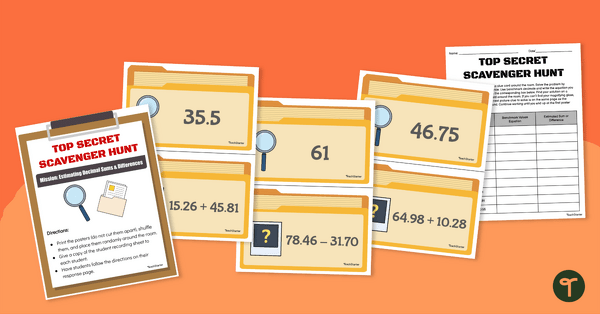
Top Secret Scavenger Hunt – Estimating Decimal Sums and Differences
Join the decimal scavenger hunt adventure! Download our printable scavenger hunt and guide your students to sharpen their estimation skills by using decimal benchmark values when finding sums and differences.
- Plus Plan
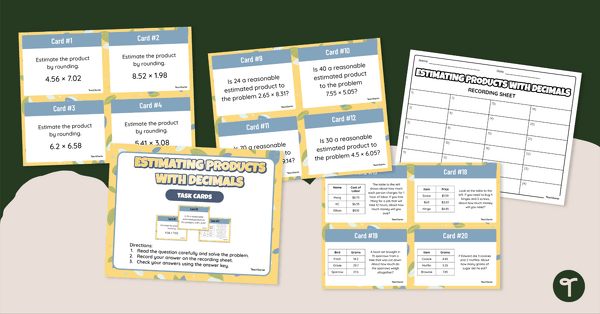
Estimating Products With Decimals Task Cards
Challenge your students to estimate before multiplying decimals with this set of 24 task cards.
- Plus Plan
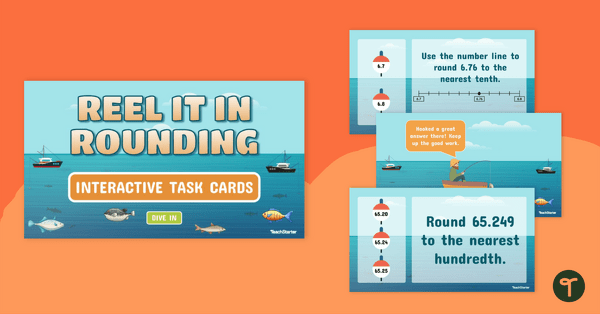
Reel It in Rounding With Decimals – Interactive Task Cards
Guide your students to tackle questions where they must round decimals to the nearest whole number, tenth and hundredth with this set of 24 interactive task cards.
- Plus Plan
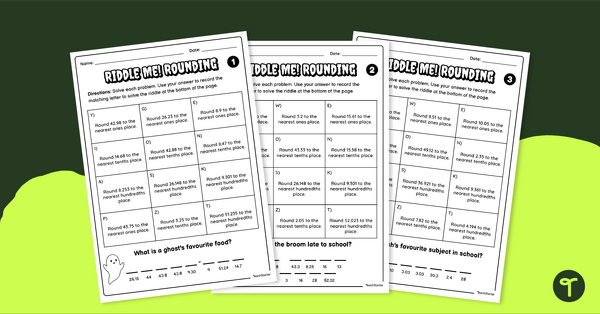
Halloween Rounding Decimals Worksheets
Have fun rounding decimals to the tenths and hundredths place with our Halloween Riddle worksheets!
- Plus Plan
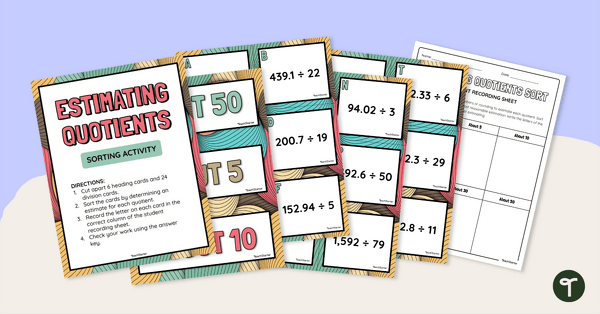
Estimating Quotients Sorting Activity
Guide your students to use rounding and compatible numbers when estimating quotients with this 24-card sorting activity.
- Plus Plan
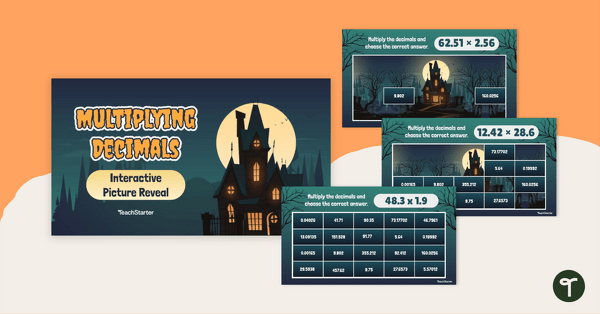
Multiplying Decimals – Interactive Picture Reveal (Halloween)
Sharpen your students' decimal multiplication skills with an interactive Halloween picture reveal.
- Plus Plan
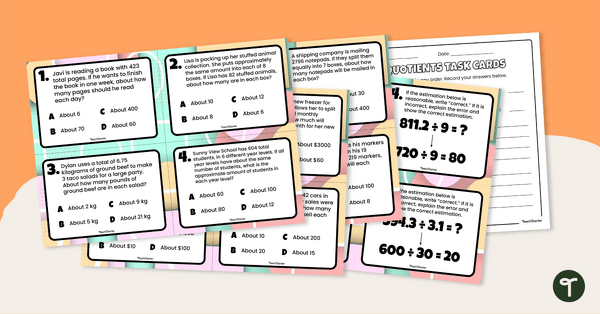
Estimating Quotients Task Cards
Give your students the opportunity to use rounding and compatible numbers to answer estimation questions with this set of 24 task cards.
- Plus Plan
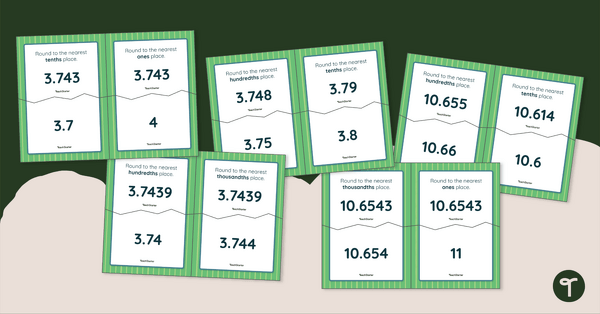
It's a Match! – Rounding With Decimals Puzzle
Practise rounding decimals up to the thousandths place with 34 puzzle pair matching pieces.
- Free Plan
Fraction, Percentage and Decimal Word Wall Vocabulary
Print your own fraction, percentage and decimal vocabulary for use on a maths word wall.
- Plus Plan
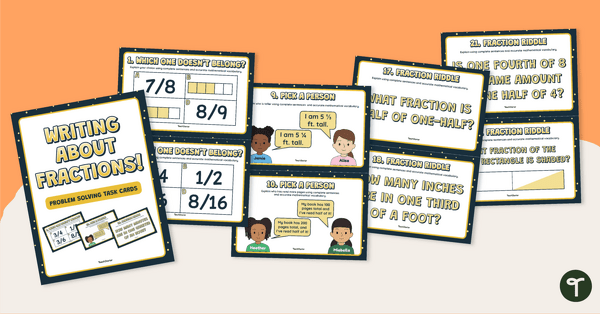
Writing About Fractions- Task Cards
Review fraction concepts and practice mathematical constructed response writing with a set of writing about fractions task cards.
- Plus Plan
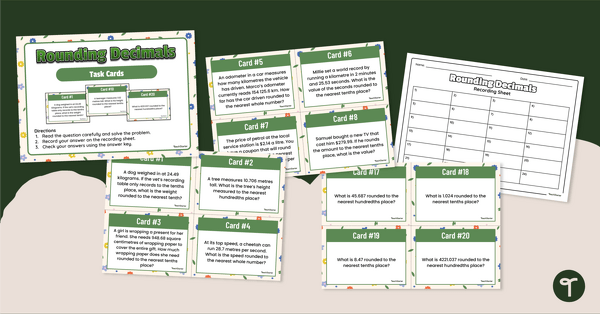
Rounding Decimals – Task Cards
Round decimals to the nearest hundredth with this set of 24 task cards.
- Plus Plan
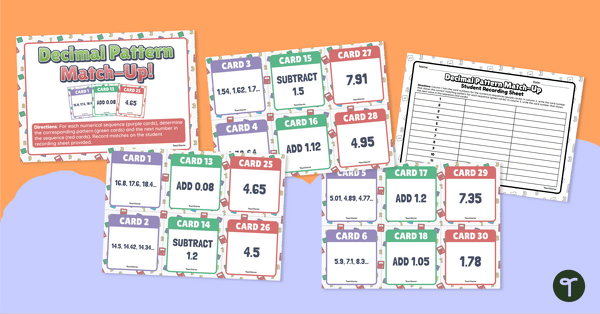
Decimal Patterns Match-Up Activity
Use this match-up activity to determine patterns and extend numerical sequences by adding and subtracting decimals.
- Plus Plan
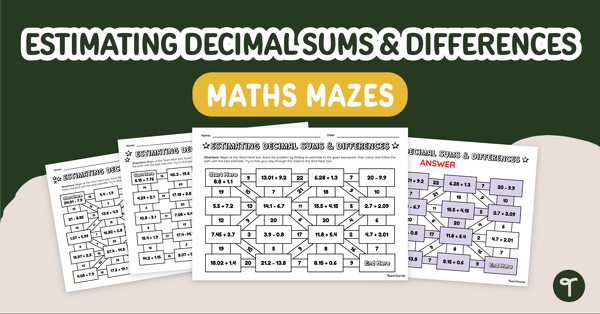
Estimating Decimal Sum and Differences — Year 6 Maths Mazes
Year 6 students can practise estimating solutions to decimal addition and subtraction equations with this set of maths mazes.
- Plus Plan
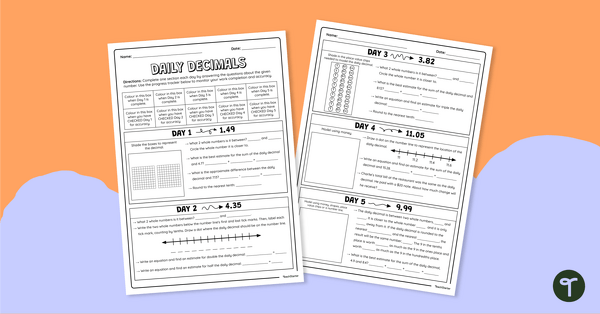
Daily Decimals Worksheet
Model decimals in various ways and use estimation skills to complete decimal calculations.
- Plus Plan
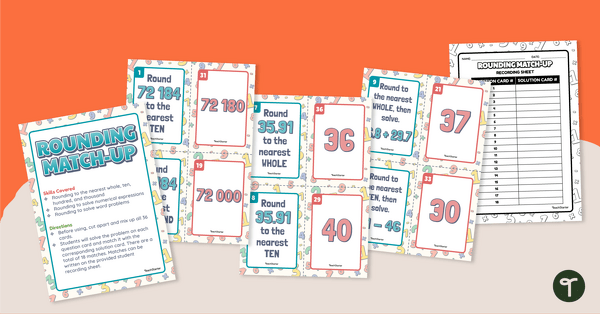
Rounding Numbers – Match-up Activity
Practise rounding decimals and whole numbers with this match-up activity.
- Plus Plan
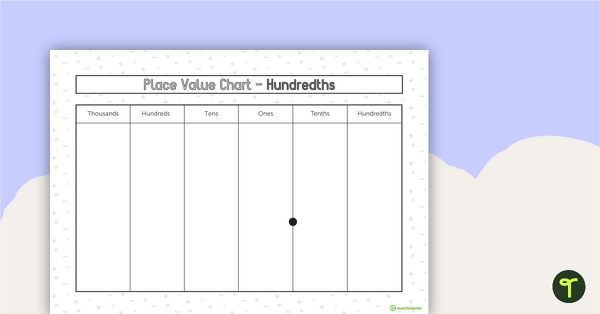
Place Value Chart - Hundredths Place
A blank place value chart to use when exploring decimal numbers.
- Plus Plan
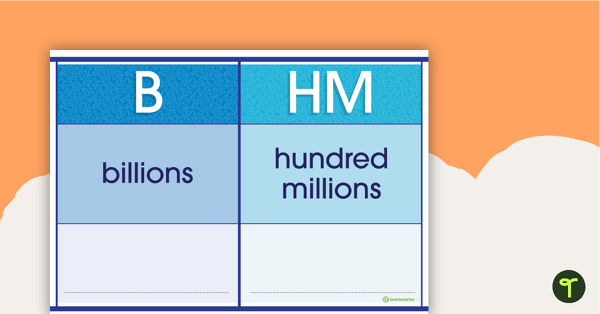
Place Value Banner - Billions to Thousandths
A banner that displays extended place value.
- Plus Plan
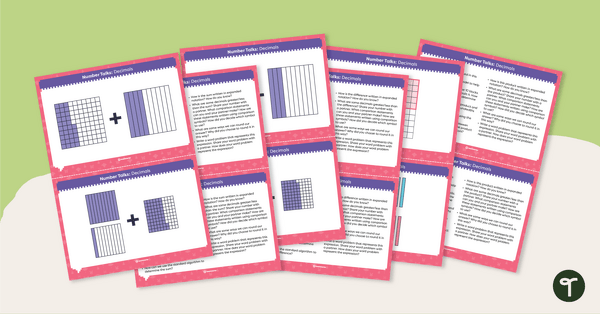
Number Talks – Decimal Operations Task Cards
Explore decimal operations with your students using this set of 26 number talk task cards.
- Plus Plan
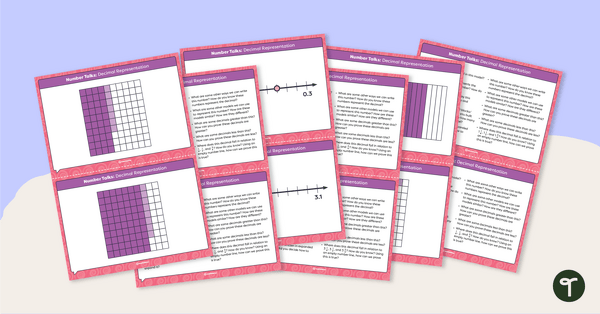
Number Talks — Decimal Representation Task Cards
Explore representations of decimals with your students using this set of 28 number talks task cards.
- Plus Plan
Fractions and Decimals Maths Activity Ideas for Parents
An information sheet for parents or carers to use when assisting children with fractions and decimals at home.
- Plus Plan
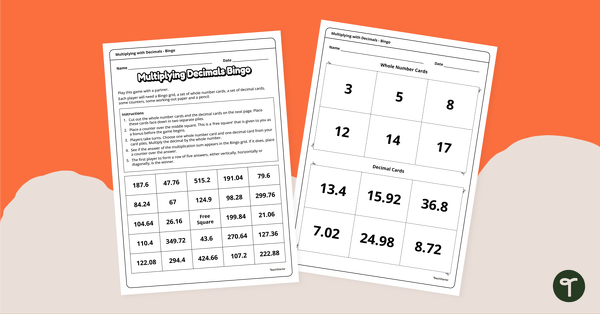
Multiplying with Decimals Bingo Game
Get your students multiplying decimals by whole numbers with this engaging Bingo game.