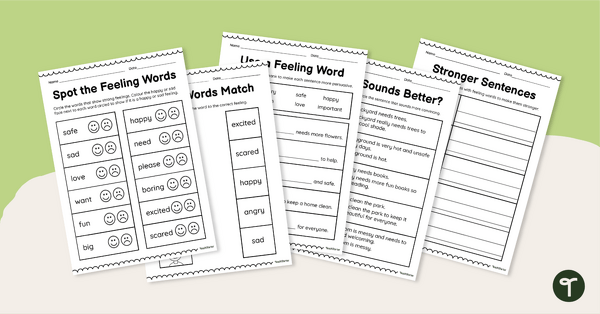
Use this emotive vocabulary worksheet set to build persuasive writing skills in your early writers.
Emotive Language Worksheets – Build Early Persuasive Writing Skills
Help your Year 1 and 2 students strengthen their persuasive writing with this engaging Emotive Vocabulary Worksheet Pack. Designed to support young learners as they move from simple statements to convincing arguments, these activities teach students how emotive language can transform their writing. Through fun, accessible tasks, children learn to recognise feeling words, choose stronger vocabulary, and apply it to make their ideas more powerful and compelling.
The worksheet pack provides a variety of activities to help students confidently use emotive language in their persuasive writing. Inside, you’ll find:
- Feeling word identification pages to build emotional vocabulary
- Matching activities to strengthen understanding of different emotions
- Sentence‑building tasks that introduce persuasive structures
- “Which sounds better?” comparisons to model strong writing choices
- Rewrite pages and paragraph practice for applying emotive language in context
- Teacher answer keys for easy checking and support
A Scaffolded Approach to Using Feeling Words in Persuasive Texts
This resource guides students’ step‑by‑step in understanding how emotions shape meaning. Children begin by identifying and matching feeling words, then practise inserting emotive vocabulary into sentences to make them sound more convincing. As they progress, they learn to compare two versions of a sentence, decide which is more persuasive, and rewrite simple lines to make them stronger. The pack also includes short paragraph tasks where students apply emotive language independently to enhance the clarity and impact of their writing.
Explore Emotive Language for Persuasive Writing Today
Introduce and explore emotive language with your students to help them understand the importance of using the correct vocabulary in their persuasive writing.
This resource was created by Lindsey Phillips, a teacher and a Teach Starter collaborator.
More Persuasive Writing Resources for the Early Years
Looking for more early years resources to help teach persuasive writing? We have you covered…
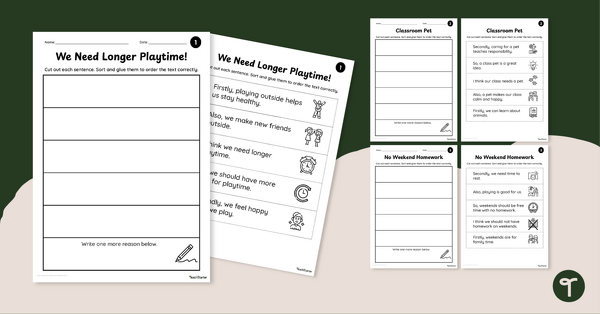
teaching resource
Build a Persuasive Text - Cut and Paste Worksheets
Use this set of basic persuasive texts to build students awareness of the structure required when writing persuasive texts with this Build a Persuasive Text worksheet set.

0 Comments
Write a review to help other teachers and parents like yourself. If you'd like to request a change to this resource, or report an error, select the corresponding tab above.