An experiment to investigate if electricity moves better through different gage wires.
Use this science investigation in your classroom when studying electricity.
Updated: 05 May 2023
An experiment to investigate if electricity moves better through different gage wires.
Non-Editable: PDF
Pages: 3 Pages
Grades: 4 - 5
Collect observations and measurements as evidence
Construct appropriate graphic organizers used to collect data, including tables, bar graphs, line graphs, tree maps, concept maps, Venn diagrams, flow charts or sequence maps, and input-output tables that show cause and effect
Analyze data by identifying significant features, patterns, or sources of error
Communicate explanations and solutions individually and collaboratively in a variety of settings and formats
Demonstrate and describe how electrical energy travels in a closed path that can produce light and thermal energy
Collect observations and measurements as evidence
Analyze data by identifying significant features, patterns, or sources of error
Communicate explanations and solutions individually and collaboratively in a variety of settings and formats
Demonstrate that electrical energy in complete circuits can be transformed into motion, light, sound, or thermal energy and identify the requirements for a functioning electrical circuit
Construct appropriate graphic organizers used to collect data, including tables, bar graphs, line graphs, tree maps, concept maps, Venn diagrams, flow charts or sequence maps, and input-output tables that show cause and effect
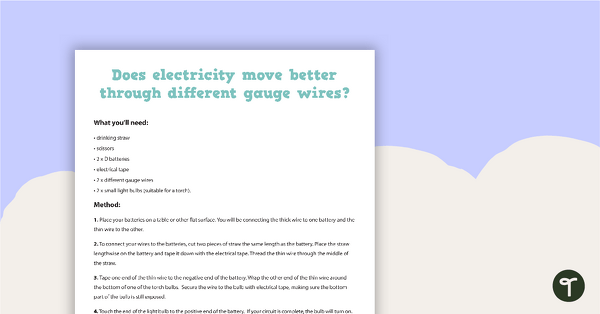
An experiment to investigate if electricity moves better through different gage wires.
Use this science investigation in your classroom when studying electricity.
Collect observations and measurements as evidence
Construct appropriate graphic organizers used to collect data, including tables, bar graphs, line graphs, tree maps, concept maps, Venn diagrams, flow charts or sequence maps, and input-output tables that show cause and effect
Analyze data by identifying significant features, patterns, or sources of error
Communicate explanations and solutions individually and collaboratively in a variety of settings and formats
Demonstrate and describe how electrical energy travels in a closed path that can produce light and thermal energy
Collect observations and measurements as evidence
Analyze data by identifying significant features, patterns, or sources of error
Communicate explanations and solutions individually and collaboratively in a variety of settings and formats
Demonstrate that electrical energy in complete circuits can be transformed into motion, light, sound, or thermal energy and identify the requirements for a functioning electrical circuit
Construct appropriate graphic organizers used to collect data, including tables, bar graphs, line graphs, tree maps, concept maps, Venn diagrams, flow charts or sequence maps, and input-output tables that show cause and effect

We create premium quality, downloadable teaching resources for primary/elementary school teachers that make classrooms buzz!
Would you like something changed or customised on this resource? While our team makes every effort to complete change suggestions, we can't guarantee that every change will be completed.
Did you spot an error on this resource? Please let us know and we will fix it shortly.
Are you having trouble downloading or viewing this resource? Please try the following steps:
If you are still having difficulty, please visit the Teach Starter Help Desk or contact us .
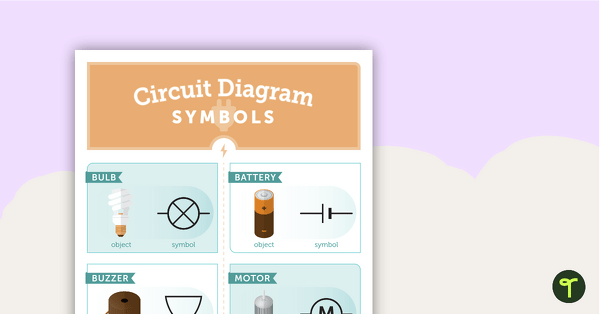
A poster that shows a range of symbols used for drawing circuit diagrams.
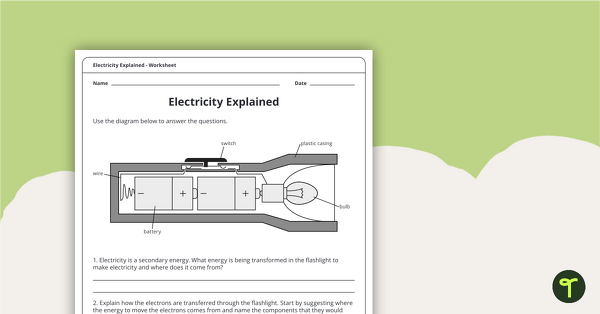
Explore the inner workings of a flashlight and discover how energy flows through a circuit with a printable Energy Transfer Worksheet.
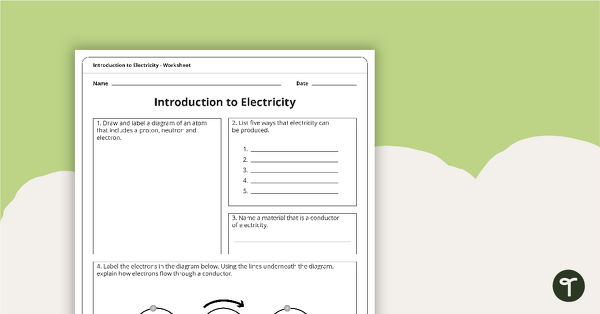
A worksheet that explores the concept of electricity.
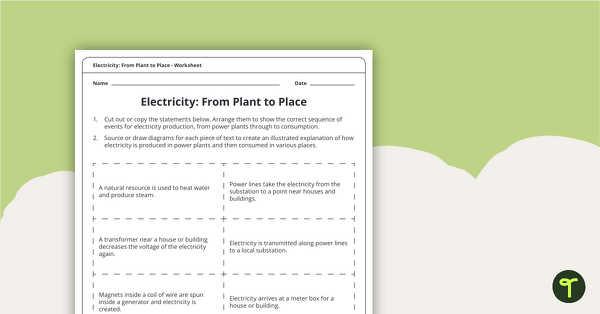
A worksheet that explores how electricity is generated and distributed.
Teach your students about electricity with this editable 23-slide teaching PowerPoint.
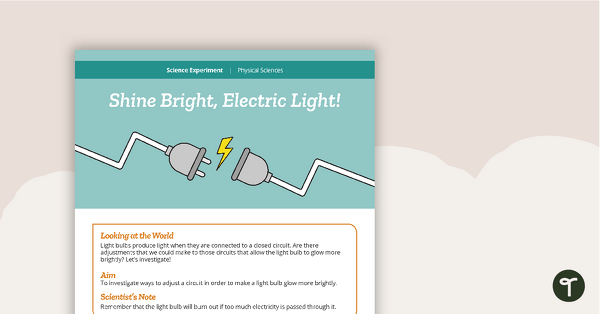
A science experiment that investigates how changes to electrical circuits affects their components.
A teaching presentation introducing the students to the non-contact force of electrostatics.
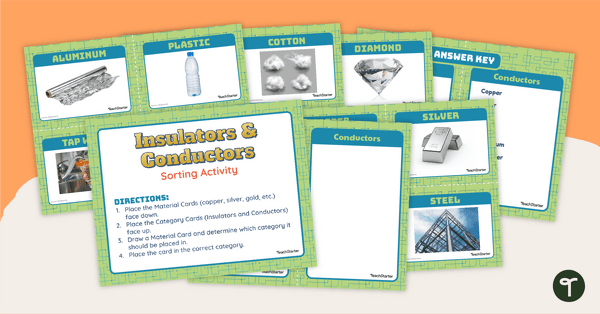
Distinguish between insulators and conductors with a picture-based sorting activity.
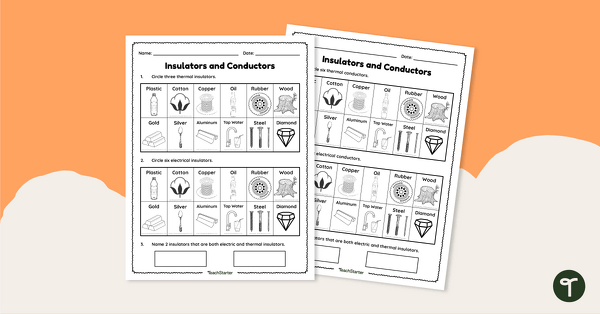
Identify different insulators and conductors of thermal and electrical energy with this worksheet.
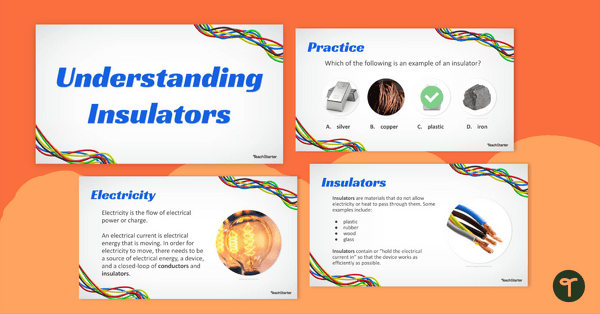
Teach your students about electrical and thermal insulators with this teaching presentation.
0 Comments
Write a review to help other teachers and parents like yourself. If you'd like to request a change to this resource, or report an error, select the corresponding tab above.