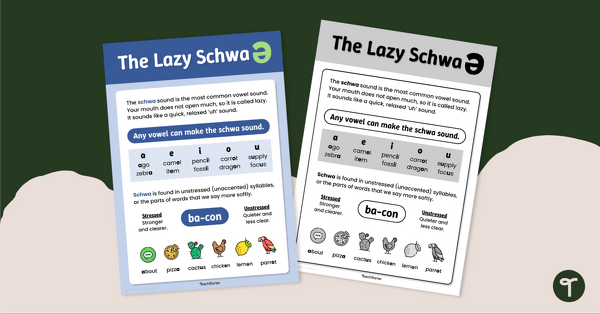
Download this schwa anchor chart to help students recognize and understand the most common vowel sound in English, building confidence when reading, spelling and decoding unfamiliar words.
A Schwa Anchor Chart for Your Elementary Classroom
If you’ve ever had your students ask why a word isn’t pronounced the way it’s spelled, the chances are the schwa sound was involved! This unstressed vowel sound appears in countless everyday words, yet it often goes unnoticed by young learners.
Understanding the schwa is an important step in developing strong phonological awareness, decoding skills and spelling knowledge. Students commonly assume that every vowel makes its expected sound, which can lead to confusion when reading and spelling words such as “about,” “problem,” “animal” or “support.” Learning about schwa helps students understand why some vowels seem to change sound in unstressed syllables, supporting more accurate word recognition.
This classroom anchor chart has been designed by the Teach Starter team to provide a clear, student-friendly explanation of the schwa sound. On the anchor chart, you will find:
- A simple explanation of what the schwa sound is
- A definition of stressed and unstressed syllables
- Clear examples of words with different vowels containing schwa
- Visual aids to help students connect sounds and words
Whether you’re introducing schwa for the first time or revisiting it as part of word study, this anchor chart gives students an easy-to-reference reminder that supports ongoing learning throughout the year. It is available as a PDF or an editable Google Slides file. You can access and print either a full-color or black-and-white version, depending on your needs.
Using This Practical Schwa Poster in Your ELA Lessons
This schwa poster is a practical teaching aid that can be used in multiple ways to support teaching and learning in your classroom. Here are some ideas from our team to get you started:
- Direct Teaching – Use the poster to introduce the schwa sound and explain how vowels can make an unstressed “uh” sound in many multisyllabic words.
- Intervention Sessions – Use the poster as a visual scaffold for students who need support with decoding multisyllabic words and connecting spelling to pronunciation.
- Group Reading Sessions – When reading aloud, encourage students to check the poster when they come across words that do not sound the way they are spelled.
Download and Display This Schwa Vowel Anchor Chart
Use the Download button to access your preferred version of this schwa vowel anchor chart. Please note that you will be required to make a personal copy of the Google Slides file before you can access it.
Whether displayed on your classroom wall or glued into student notebooks, this resource provides ongoing support as students develop their understanding of the schwa sound and apply that knowledge to reading and spelling tasks.
If you intend to display this poster on your classroom wall, we recommend enlarging the size when printing for enhanced readability.
This resource was created by Lindsey Phillips, a teacher in Michigan and a Teach Starter collaborator.

0 Comments
Write a review to help other teachers and parents like yourself. If you'd like to request a change to this resource, or report an error, select the corresponding tab above.