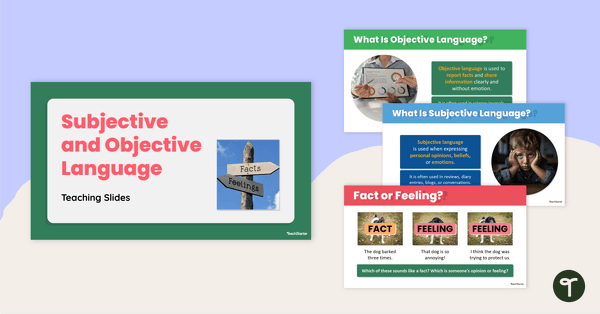
Teach your students how to confidently identify subjective and objective language in texts with this engaging, age-appropriate slide deck.
Teach Subjective and Objective Language with Confidence
Our students are growing up in a world that is saturated with information. Now, more than ever, it is vital we teach our students how to tell the difference between facts and opinions. One key aspect of this skill is knowing the difference between subjective and objective language.
This comprehensive 17-slide teaching presentation has been created by our team to help your students distinguish between subjective and objective language using vocabulary cues. The slide deck will teach your students:
- The definitions of subjective and objective language
- The features of subjective and objective language
- Examples of subjective and objective language
- When to use subjective and objective language
This thoughtfully designed slide deck introduces the concept of subjective and objective language in a clear, age-appropriate way. The structured layout supports explicit instruction, with opportunities for guided practice and class discussion. The resource also contains review activities to help you see whether students have mastered the concept or if more explicit teaching is required.
Activities for Exploring the Difference Between Objective and Subjective Language
Looking for some activity ideas to allow students to demonstrate their newfound understanding of objective and subjective language? Here are some you might like to consider:
- Daily Warm-Up – Start each day by writing a fact or opinion sentence on the board. Students decide if it’s subjective or objective and explain why in their writing journals or during a quick class discussion.
- Media Detective – Show students short news clips, advertisements or social media posts. Ask them to identify examples of subjective and objective language and discuss why the author might have chosen one over the other.
- Two-Voice Writing Challenge – Have students write two short paragraphs on the same topic: one using objective language and one using subjective language. For example, they could write a paragraph about a subject taught at school, with one paragraph focused on facts about the subject and the other on personal opinions.
Download This Objective and Subjective Language Presentation
This slideshow downloads as either a Microsoft PowerPoint or Google Slides presentation. Use the dropdown menu on the Download button to access your preferred version. (Note: You will be prompted to make a copy of the Google Slides presentation before accessing it.)
These editable file formats can be easily adapted to suit your teaching style and your students’ needs.
This resource was created by Kaylyn Chupp, a teacher in Florida and a Teach Starter collaborator.
More Examples of Objective and Subjective Language
Click below to browse more teacher-created, curriculum-aligned resources for teaching your students about being subjective or objective when speaking and writing.
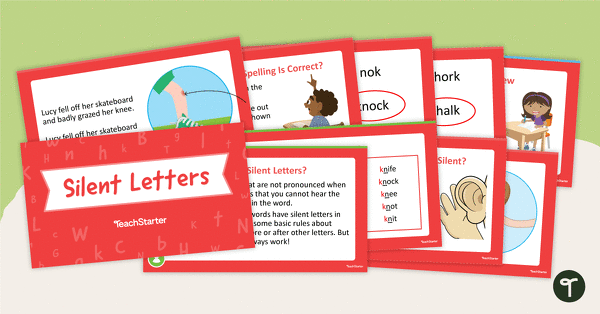
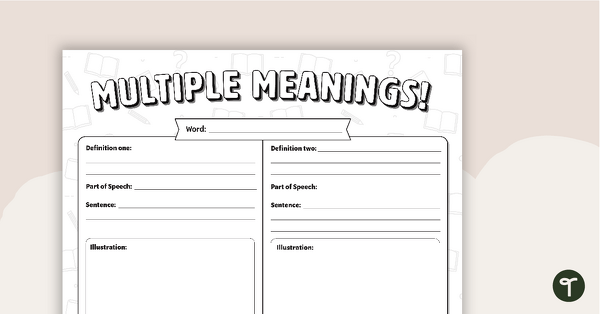
[resource:5164814] [resource:5145573] [resource:5156438]

5 Comments
Write a review to help other teachers and parents like yourself. If you'd like to request a change to this resource, or report an error, select the corresponding tab above.
No comments yet.