Multiplication Teaching Resources
Teach multiplication with ease this school year with free printable multiplication worksheets, digital activities, games and more to help students understand how to multiply numbers and apply multiplication strategies to maths problems.
This teaching resource collection was created by the teachers on the Teach Starter team for primary teachers, and each Australian curriculum-aligned resource has been carefully reviewed and curated to ensure it's ready to use with your students!
Explore multiplication charts and tables, methods for explaining the associative and commutative properties and more, plus find differentiated resources to help you meet each student's needs!
Want to learn more about multiplication? Read on for a primer from our teacher team!

What Is Multiplication? A Kid-Friendly Definition
Introducing multiplication to your class? Let's get started with a definition of this maths operation that's easy for them to understand.
Multiplication is the process of adding a number to itself many times. It's a simple way to figure out how much you'll have when you add the same number again and again.
Let's look at an example.
Pretend you have 3 apples, and you want to multiply them by 4.
If you did this, you would have 12 apples because you added 3 apples to itself four times (3 + 3 + 3 + 3 = 12).
Multiplication Terms
Launching into multiplication in your maths class involves plenty of new vocabulary words for your students to learn! Here are some of the terms you will want to start with.
Product
The product of a multiplication problem is the result of multiplying two or more numbers together. It's the answer to your maths problem!
Partial Product
If the product is the answer, what's a partial product? This is the name of each product when you break apart the factors and multiply the parts in a multi-digit number. While there are many ways to solve multiplication problems with partial products, the box method is a common strategy to help students break apart each factor before multiplying.
Factor
In multiplication, the factor is the number that is multiplied by another number to get a product. For example, in the problem 3 x 4 = 12, the numbers 3 and 4 are factors, and the product is 12.
Multiplication Table
Sometimes called a times table, a multiplication table that shows the products of all the possible combinations of two numbers.
What Is the Associative Property of Multiplication?
The associative property of multiplication means we can change the grouping of the multiplied factors, and it won't change the product. For example:
- (2 x 3) x 4 = 2 x (3 x 4) = 24
No matter how we group the multiplied factors, the product will always be the same!
What Is the Commutative Property of Multiplication?
The commutative property of multiplication means we can change the order of the multiplied factors without changing the product. For example:
- 3 x 4 = 4 x 3 = 12
This means we can multiply the factors in any order and still get the same result!

A cartoon version of the multiplication symbol
What Is the Distributive Property of Multiplication?
Another property of multiplication students learn in elementary school is distributive. This means we can distribute a factor across the sum or difference of two other factors.
This property is handy for breaking down a more complicated multiplication problem.
Let's look at an example:
- 4 x (3 + 2)
We can use the Distributive Property to rewrite this expression as:
- (4 x 3) + (4 x 2)
Now we can simplify each of these products separately:
- 12 + 8 = 20
Using the distributive property, we can work out that the original problem 4 x (3 + 2) — is equivalent to 20.
What Is the Identity Property of Multiplication?
The identity property of multiplication lets you simplify multiplication problems involving the number 1. When we multiply any number by 1, the product is the same as the original number!
Let's say we have the problem 5 x 1. When we apply the identity property, we know that the product of 5 and 1 is 5 itself since 1 is the multiplicative identity!
- Plus Plan
Be a Groupie
A 60 minute lesson in which students explore multiplication through its representation as groups of objects.
- Plus Plan
Early Multiplication Unit Plan
This Mathematics unit covers a range of concepts relating to early multiplication skills.
- Plus Plan
Early Multiplication – Assessment
An assessment task in which students will demonstrate their knowledge and understanding of multiplication.
- Plus Plan
Multiples Everywhere
A 60 minute lesson in which students apply knowledge and understanding of multiplication to a real-world context.
- Plus Plan
Arrays of Sunshine!
A 60 minute lesson in which students explore the concept of arrays.
- Plus Plan
Skip Count to Multiply
A 60 minute lesson in which students use knowledge of skip counting in order to add multiples of the same number.
- Plus Plan
Repeat That Adding
A 60 minute lesson in which students explore multiplication through its representation as repeated addition.
- Plus Plan
Sound Groups for Teaching Multiplication Video
Teach your students about equal groups in multiplication with this engaging video that combines multiplication with music!
-
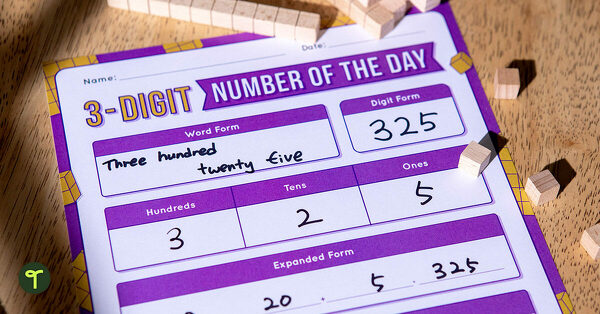
Tips for Teaching Place Value: Teachers' Favourite Strategies + Activities
Check out some teacher-tested strategies and activities to make place value stick for your students!
-
What Is a Bar Model? How to Use This Maths Problem-Solving Method in Your Classroom
The Bar Model is a popular strategy for mathematical problem solving, so how do you use it in your classroom, and should you?
- Multiplication Worksheets
- Multiplication Games
- Multiplication Posters
- Multiplication Teaching Presentations
- Multiplication Flashcards
- Multiplication Templates
- Multiplication for Year 1
- Multiplication for Year 2
- Multiplication for Year 3
- Multiplication for Year 4
- Multiplication for Year 5
- Multiplication for Year 6
- Multiplication for Year 7