teaching resource

Science Experiment - Angles of Reflection

  • Updated

    Updated:  04 Oct 2023

A science experiment that explores reflected light.

  • Non-Editable

    Non-Editable:  PDF

  • Pages

    Pages:  5 Pages

  • Curriculum
  • Year

    Year:  5

Curriculum

  • VC2S6U08

    Light from a source forms shadows and can be absorbed, reflected and refracted

  • VC2S6I02

    With guidance, plan appropriate investigation types to answer questions or solve problems and use equipment, technologies and materials safely, identifying potential risks

  • VC2S6I04

    Construct and use a range of representations, including tables and graphs, to record, represent and describe observations, patterns or relationships in data

  • VC2S6I03

    Equipment can be used to observe, generate, measure and record data with reasonable precision for repeated measurements, using digital tools as appropriate <ul> <li>recording data using standard units such as the volt, ampere, gram, second and metre, and developing the use of standard prefixes for metric units, such as ‘kilo-’ and ‘milli-’</li> <li>using digital tools such as digital thermometers and soil moisture probes to collect data over time, and recording data in spreadsheets</li> <li>discussing why precision is important in measurement, and comparing the precision of different class data sets, for example the growth of radish seeds in different soil environments and the length of shadows at different times of the day</li> </ul> <!--a=1-->

teaching resource

Science Experiment - Angles of Reflection

  • Updated

    Updated:  04 Oct 2023

A science experiment that explores reflected light.

  • Non-Editable

    Non-Editable:  PDF

  • Pages

    Pages:  5 Pages

  • Curriculum
  • Year

    Year:  5

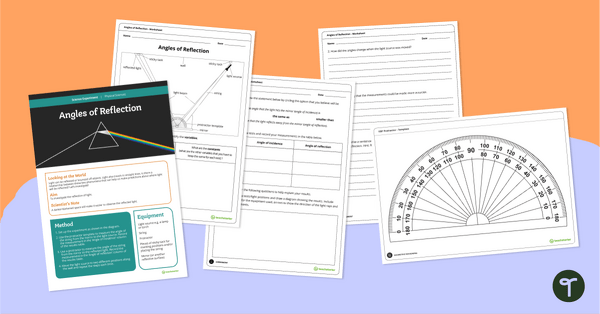
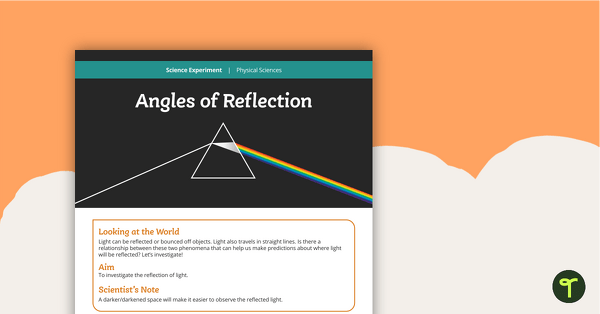
A science experiment that explores reflected light.

Can we predict where light will be reflected? Let’s investigate!

This Physical Sciences experiment allows students to investigate the relationship between the angles of incidence and reflection. It also allows young scientists to demonstrate their ability to design a fair test and follow the experiment procedure.

Students follow the scientific method to conduct the experiment in small groups, then complete the provided worksheet.

0 Comments

Write a review to help other teachers and parents like yourself. If you'd like to request a change to this resource, or report an error, select the corresponding tab above.

Log in to comment

You may also like