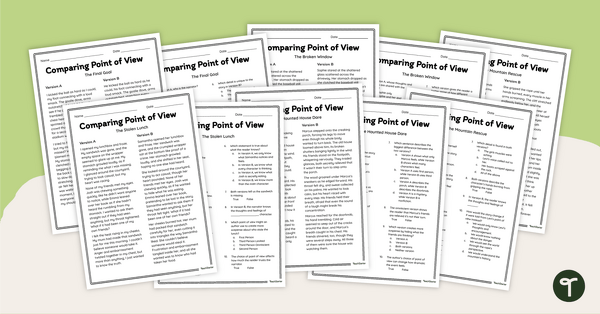
Teach how narrative voice shapes the reader's experience of texts with this set of worksheets where students compare passages written from different points of view.
Compare Narrative Voice Across Texts
Narrative voice is one of the most important elements of storytelling, as it shapes the way readers experience a text. The most common forms of narrative voice include first person, third person limited and third person omniscient.
This resource pack includes five worksheets where students compare two short passages written in different narrative voices. After reading the texts, students answer comprehension and reflection questions that help them analyse the effect of narrative voice on meaning.
The texts featured in this resource are:
- The Stolen Lunch
- The Haunted House Dare
- The Final Goal
- The Broken Window
- The Mountain Rescue
This resource downloads as a black-and-white PDF or editable Google Slides file. Answers are also included in the download. By engaging in this activity, learners will gain a deeper awareness of how narrative choices influence meaning and reader engagement.
Exploring Voice in Narrative Through Comparison
This resource has been designed to strengthen your students’ reading comprehension and analytical skills as they identify and explain how voice in narration affects the reader’s experience of the text.
Here are some tips to maximise their success while engaging with this resource:
- Read each passage carefully to pick up on subtle differences in perspective.
- Highlight pronouns and key phrases that give clues about who is telling the story.
- Note what the narrator knows (or doesn’t know) to spot the type of narration.
- Compare how each passage feels. Is one more personal, distant or all-knowing?
- Support answers with textual evidence where necessary.
These tips will help your students understand narrative voice more clearly and answer the questions with confidence!
Download These Voice and Narration Worksheets
Getting started with this resource is simple. Use the Download button above to access the full set of passages, accompanying questions and associated answer pages.
As this resource contains answer pages, we recommend printing one copy of the entire file, then selecting and removing the pages you wish to photocopy for the students.
With five ready-to-use worksheets included, you’ll have enough material to cover whole-class lessons, small group practice or individual tasks.
This resource was created by Kaylyn Chupp, a teacher and a Teach Starter collaborator.
Teaching Narrative Voice and Point of View? We Have You Covered!
Looking for more resources to use when exploring narrative voice and point of view with your students? Click below to browse a sample from our extensive library.
[resource:5171793] [resource:5171303] [resource:5171680]

0 Comments
Write a review to help other teachers and parents like yourself. If you'd like to request a change to this resource, or report an error, select the corresponding tab above.