VC2M4N06
develop efficient mental and written strategies and use appropriate digital tools for solving problems involving addition and subtraction, and multiplication and division where there is no remainder
- using and choosing efficient calculation strategies for addition and subtraction problems involving larger numbers, for example, place value partitioning, inverse relationship, compatible numbers, jump strategies, bridging tens, splitting one or more numbers, extensions to basic facts, algorithms and digital tools where appropriate
- using physical or virtual materials to demonstrate doubling and halving strategies for solving multiplication problems; for example, for 5 × 18, using the fact that double 5 is 10 and half of 18 is 9; or using 10 × 18 = 180, then halving 180 to get 90; or applying the associative property of multiplication, where 5 × 18 becomes 5 × 2 × 9, then 5 × 2 × 9 = 10 × 9 = 90 so that 5 × 18 = 90
- using an array to represent a multiplication problem, connecting the idea of how many groups and how many in each group with the rows and columns of the array, and writing an associated number sentence
- using materials or a diagram to solve a multiplication or division problem, by writing a number sentence and explaining what each of the numbers within the number sentence refers to
- representing a multiplicative situation using materials, array diagrams and/or a bar model, and writing multiplication and/or division number sentences, based on whether the number of groups, the number per group or the total is missing, and explaining how each number in their number sentence is connected to the situation
- using place value partitioning, basic facts and an area or region model to represent and solve multiplication problems; for example, for 16 × 4, thinking 10× 4 and 6 × 4, then 40 + 24 = 64, or a double double strategy where double 16 is 32, double this is 64, so 16 × 4 is 64
- Plus Plan
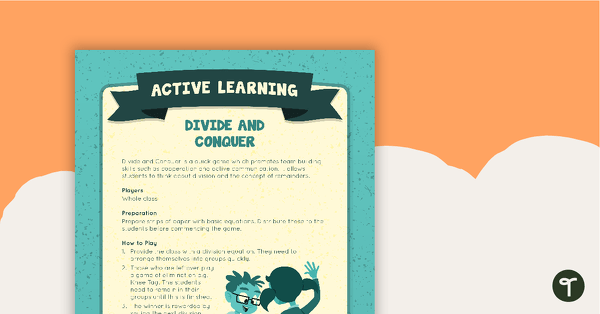
Divide and Conquer Active Learning
A whole class active game that encourages learning through a physical setting.
- Plus Plan
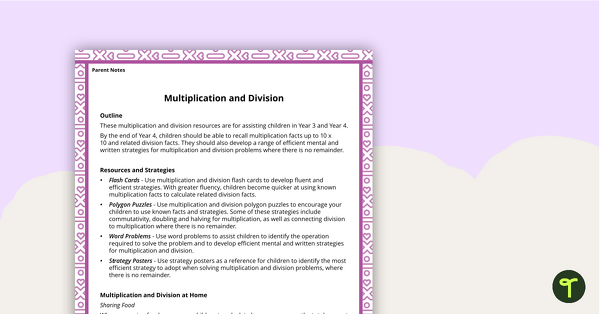
Maths Activity Ideas for Parents - Multiplication and Division
An information sheet for parents or carers to use when assisting children with multiplication and division at home.
- Plus Plan
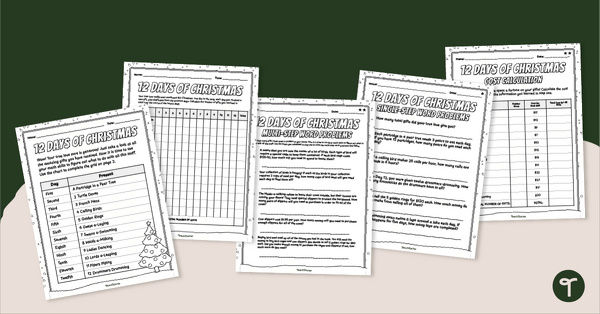
12 Days of Christmas Maths Activity
Try our 12 Days of Christmas Maths Activity pack to get your students thinking, calculating and solving problems related to the holiday song.
- Plus Plan
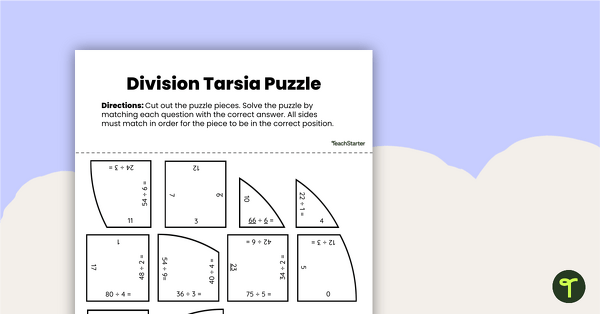
Dot Day Tarsia - Division Practice Sheets
Practise dividing two-digit by one-digit numbers with Tarsia-Style Division Practice Sheets.
- Plus Plan
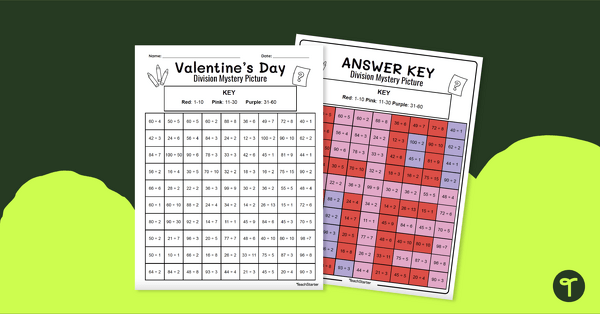
Valentine-Themed Mystery Picture - Division Facts
Have fun with your Valentine’s Day Maths lessons with a division colour by number worksheet!
- Plus Plan
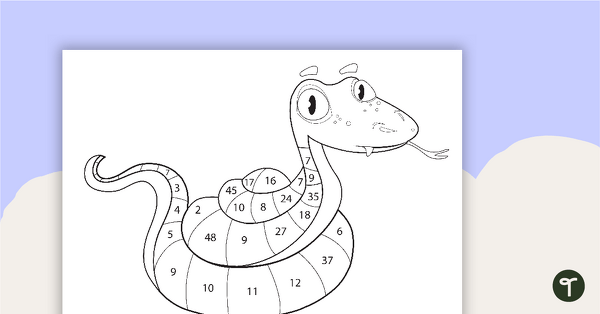
Colouring by Larger Numbers - Operations
Colouring pages to be used when working with operations.
- Plus Plan
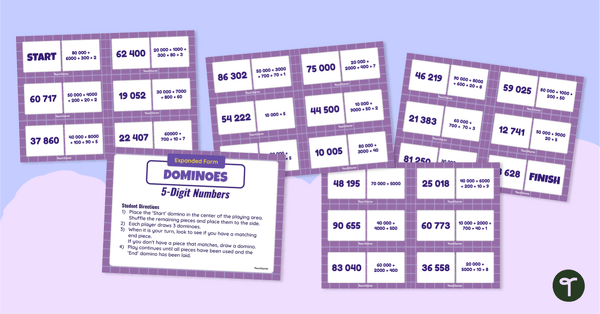
Expanded Notation Dominoes (5-Digit Numbers)
Use this set of dominoes when learning how to match 5-digit numbers written in standard form and expanded form.
- Plus Plan
Number Talks Teaching Resource Pack - Grade 4
A collection of number talks teaching resources that support meaningful and highly engaging conversations in the mathematics classroom.
- Plus Plan
Maths Resource Pack for Parents - Multiplication and Division
A comprehensive resource pack for parents to help Year 3 and Year 4 children with multiplication and division.
- Plus Plan
Maths Resource Packs for Parents - Addition and Subtraction
An extensive collection of resources for for parents to help Year 3 and Year 4 children with addition and subtraction.
- Plus Plan
Rounding Numbers to 10, 100 and 1000
A 60 minute lesson in which students will round 5-digit numbers to the nearest 10, 100 and 1000.
- Plus Plan
Exploring 5-Digit Place Value - Assessment
An assessment task in which students will demonstrate an understanding of place value in the tens of thousands.
- Plus Plan
Expanding Numbers Beyond 10 000
A 60 minute lesson in which students will investigate how place value can be used to expand numbers.
- Plus Plan
Partitioning Numbers Beyond 10 000
A 60 minute lesson in which students will investigate how place value can be used to partition numbers into smaller parts.