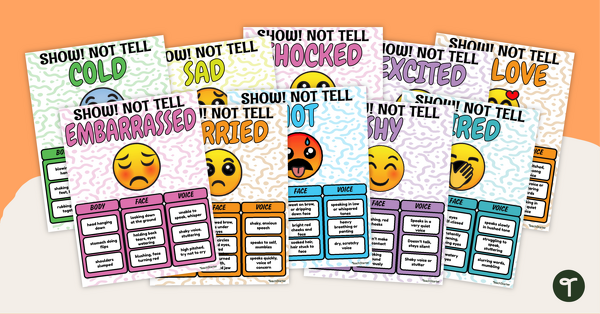
Use this set of Show, Don’t Tell posters to help your students describe character emotions through vivid details instead of simple statements.
Show Don’t Tell Character Feelings
How many times have you read simple statements like, “She was sad,” or “He felt nervous” in your students’ writing? It’s time to transform these sentences from dull to descriptive with this set of Show Don’t Tell posters!
The concept of “showing, not telling” means revealing a character’s feelings through words, facial expressions and body movements rather than simply stating the emotion. This resource features 11 common emotions and provides practical examples of how to describe these feelings by showing, not telling!
Here’s an example for the emotion “afraid”:
- Voice – He let out a high-pitched squeal.
- Face – His eyes wide in fear, he hid behind his hands.
- Body – He jumped backwards, withdrawing anxiously.
This set of Show Don’t Tell posters features the following emotions:
- Happy
- Sad
- Afraid
- Shy
- Excited
- Nervous
- Angry
- Worried
- Frustrated
- Tired
- Surprised
This resource is available as a full-color PDF or editable Google Slides file. If you have limited color printing available at your school, we recommend printing in grayscale on colored paper.
Read on to learn more about using these posters to support classroom lessons and independent practice.
Creative Ways to Use Show Don’t Tell Examples
While this poster pack makes a great classroom display, these show don’t tell examples can be used in multiple ways to spark your students’ creative imaginations. Here are some ideas from our team:
- Writing Warm-Ups – Start the day with a quick activity where students choose an emotion from the poster and write a descriptive sentence showing that feeling.
- Drama Connection – Have students act out an emotion using body language and then write what they observed, reinforcing the concept visually and kinesthetically.
- Story Starters – Use the posters to spark ideas for short stories. For example, “What happened before this character clenched their fists and narrowed their eyes?”
Download to Teach How to Show Not Tell in Writing
Use the Download button to access the full-color printable PDF or editable Google Slides file. Note that you will be prompted to make a personal copy of the Google Slides file.
Display these posters in the classroom, use them as scaffolds during writing lessons or print smaller versions for student reference. They’re perfect for whole-class lessons, writing workshops or as part of a literacy center.
Resources to Support These Show and Don’t Tell Posters
Has this resource piqued your interest in our resources aimed at improving your students’ creative writing abilities? Click below for more teacher-created resources to use in your classroom!
[resource:5089244] [resource:4477383] [resource:2655182]

0 Comments
Write a review to help other teachers and parents like yourself. If you'd like to request a change to this resource, or report an error, select the corresponding tab above.