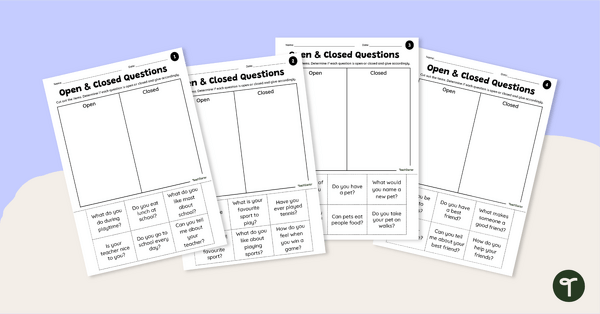
Help your students build critical thinking and communication skills with this engaging Open and Closed Questions resource.
Open and Closed Questions Sorting Worksheet Set
Designed as a hands-on activity, this set of worksheets helps students identify, compare, and sort questions based on their type. By working through this open and closed questions activity, learners develop an understanding of how different types of questions work and how they can affect conversations, discussions, and inquiry.
Each worksheet has three open question examples and three closed question examples for students to cut out and paste into their corresponding headings.
Understanding the Difference Between Open and Closed Questions
This resource gives students clear examples to help them understand the difference between open and closed questions.
- Open questions encourage longer responses and deeper thinking, such as “Why do you think…?” or “How might this change…?”
- Closed questions usually lead to a short or one-word answer, such as “Did you…?” or “Is it…?”
By sorting and classifying questions, students learn how to choose the right type of question for different purposes, making this an excellent tool for literacy lessons, speaking and listening activities, and inquiry-based learning.
Printable Open and Closed Questions Worksheet PDF
The Open and Closed Questions Worksheet PDF is ready to print and use in your classroom. Each worksheet encourages students to cut, sort, and categorise questions, making the activity interactive and accessible.
Use the dropdown menu to choose between the easy to print PDF or the editable Google Slid version of this cut-and-paste worksheet.
This resource was created by Lindsey Phillips, a teacher and Teach Starter Collaborator.
More Resources for Interacting with Others
Looking for more resources to teach students the importance of interacting with others? We have you covered…
[resource:4992910] [resource:5146617] [resource:4489592]

0 Comments
Write a review to help other teachers and parents like yourself. If you'd like to request a change to this resource, or report an error, select the corresponding tab above.