VC2E4LY09
use comprehension strategies, such as visualising, predicting, connecting, summarising, monitoring and questioning, to expand topic knowledge and ideas, and begin to evaluate texts to build literal and inferred meanings
- making connections between information in print, images and sound
- reading or listening for key topic-specific vocabulary words to build understanding
- reading or listening to interpret the main idea and supporting ideas
- identifying evidence and reasoning used by authors to support points or arguments
- applying self-monitoring strategies such as re-reading, pausing and questioning, and self-correction strategies such as confirming and cross-checking
- connecting the use of colours, images, symbols and patterns in texts by Aboriginal and Torres Strait Islander authors and illustrators
- evaluating an author’s use of evidence to support arguments
- Plus Plan
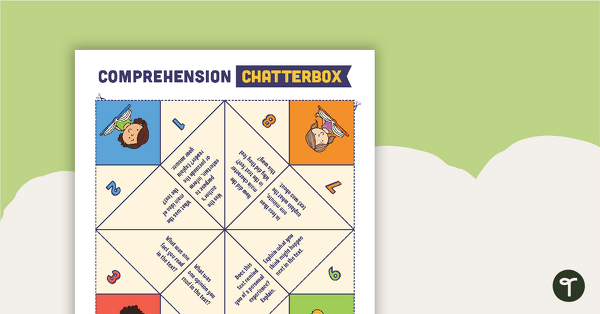
Comprehension Chatterbox
A fun reading comprehension strategy activity for students to use after reading a text.
- Plus Plan
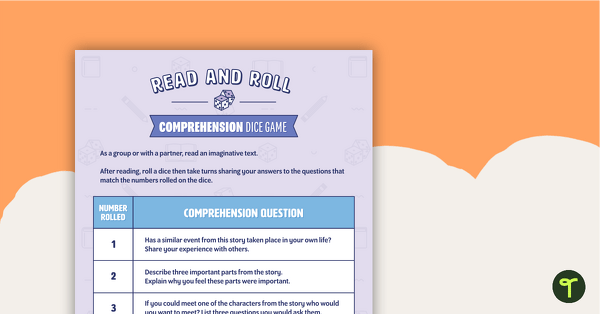
Read and Roll - Comprehension Dice Game
A fun reading comprehension strategy game to play in the classroom during literacy groups.
- Plus Plan
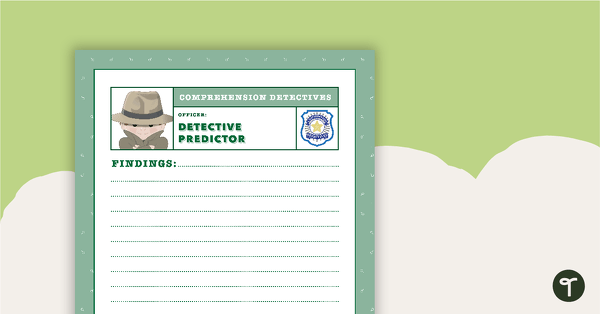
Reading Detectives Worksheets
8 reading detective worksheets to use during guided reading sessions in the classroom.
- Plus Plan
Comprehension Strategy Teaching Resource Pack - Finding Word Meaning in Context
A comprehensive resource pack to help students understand how to work out the meaning of words in context.
- Plus Plan
Comprehension Strategy Teaching Resource Pack - Making Predictions
An extensive resource pack helping students to learn how to make predictions.
- Plus Plan
Comprehension Strategy Teaching Resource Pack - Recalling Facts and Details
A comprehensive resource pack helping students learn how to recall facts and details.
- Plus Plan
Applying Reading Comprehension Strategies Unit Plan
This English unit is designed to explicitly teach the reading comprehension strategies of activating prior knowledge, making connections, questioning, monitoring, predicting, inferring, visualising and summarising to upper primary students, with a focus on literary texts.
- Plus Plan
Developing Informative Writing Skills Unit Plan - Year 3 and Year 4
This English unit addresses the informative text type; specifically, how to write a well-structured informative text.
- Free Plan
Research Skills - Note Taking
A 60 minute lesson in which students will take appropriate notes from an informative text.
- Plus Plan

Developing Informative Writing Skills Unit Plan - Year 3 and Year 4
This English unit addresses the informative text type; specifically, how to write a well-structured informative text.
- Plus Plan
Summarising
A 60 minute lesson in which students will learn and apply the reading comprehension strategy of summarising.
- Plus Plan
Visualising
A 60 minute lesson in which students will learn and apply the reading comprehension strategy of visualising.
- Plus Plan
Activating Prior Knowledge
A 60 minute lesson in which students will learn and apply the reading comprehension strategy of activating prior knowledge.
- Plus Plan
Inferring
A 60 minute lesson in which students will learn and apply the reading comprehension strategy of inferring.
- Plus Plan
Making Connections
A 60 minute lesson in which students will learn and apply the reading comprehension strategy of making connections.
- Plus Plan
Predicting
A 60 minute lesson in which students will learn and apply the reading comprehension strategy of predicting.
- Plus Plan
Questioning
A 60 minute lesson in which students will learn and apply the reading comprehension strategy of questioning.