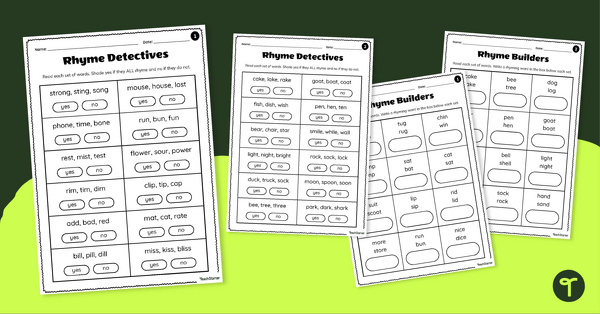
Use this Rhyming Worksheet Set to help students strengthen phonological awareness and build early reading confidence.
Rhyming Worksheets for Early Readers
Support your Early Years students as they explore rhyming patterns with two engaging worksheet types: Rhyme Detectives and Rhyme Builders.
- In Rhyme Detectives, students read sets of words, such as strong, sting, song or run, bun, fun, and decide whether all the words rhyme. This simple yes/no format helps learners listen closely to ending sounds and develop phonemic awareness.
- In Rhyme Builders, students take pairs of words like clean/queen, tug/rug, cake/lake, or moon/spoon and write a new rhyming word in the box. These tasks encourage students to apply their knowledge of word families, onset‑rime patterns, and spelling patterns.
With CVC words, common high frequency words and familiar vocabulary, this set provides repeated practice that supports decoding, fluency and early writing skills.
How to Teach Rhyming Skills to Young Students
Rhyming is a foundational phonological skill that helps students hear patterns in language and build stronger decoding abilities. These worksheets break the process into simple, kid‑friendly steps that guide learners to listen for matching ending sounds, compare word families, and generate new rhyming words.
The mix of real words (fish, dish, wish) and trickier sets (bear, chair, star) encourages students to think carefully about sound rather than spelling. Teachers can model sounding out each word, highlight the rime, and show how changing the beginning sound creates a new rhyme.
Simple steps for modeling:
- Read each word aloud — emphasize the ending sound.
- Listen for matching rimes — ask students which words “sound the same at the end.”
- Sort yes/no sets — discuss why a set does or doesn’t rhyme.
- Build new rhyming words — model changing the onset to create a rhyme.
- Check for real vs. nonsense words — encourage students to test their rhymes.
- Practice independently — guide students through the next worksheet.
Download and Explore Rhyming Today
Download the Rhyming Worksheet Set to support phonics lessons, literacy centers, and small‑group reading instruction. With clear directions, engaging word sets, and early‑elementary friendly vocabulary, this resource is an excellent way to build foundational phonological awareness.
Lindsey Phillips, a teacher and Teach Starter collaborator, contributed to this resource.
More Phonics and Word‑Study Activities
Looking for more phonics and rhyming resources for your classroom? We have you covered…
[resource:5191251] [resource:5176232] [resource:3177782]

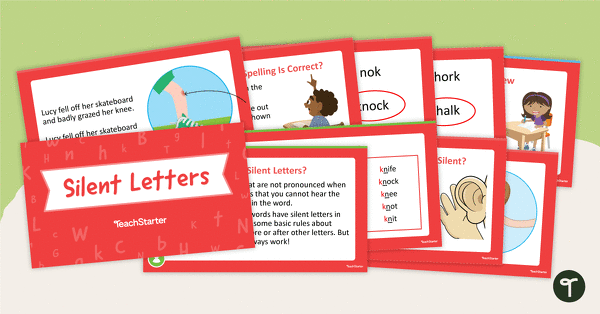
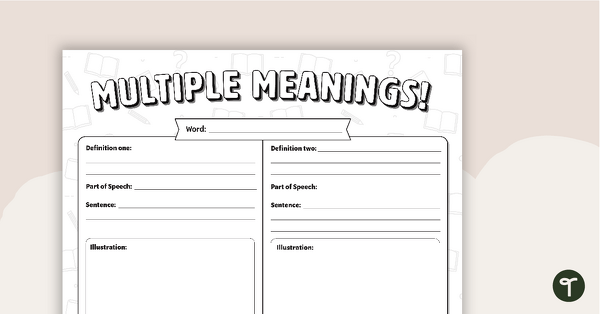
0 Comments
Write a review to help other teachers and parents like yourself. If you'd like to request a change to this resource, or report an error, select the corresponding tab above.