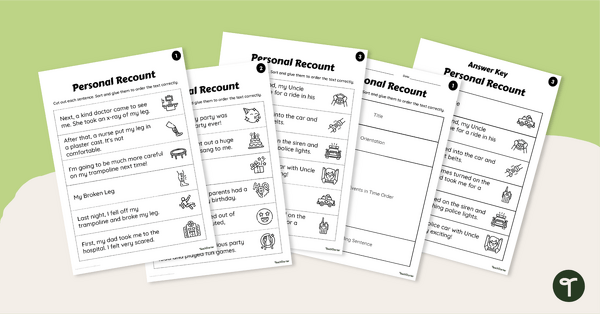
Use this set of simple personal recounts to help students learn the structure of a recount by reading, identifying key features, and sequencing events into the correct order.
Personal Recount Sequencing Activity
Help students develop their understanding of personal recount structure and sequencing language with this interactive cut-and-paste task. In this activity, students are given a mixed-up personal recount. Their task is to carefully read each sentence, then cut and paste them into the correct order based on their knowledge of how a personal recount is structured.
Students will practise identifying:
- Orientation (who, where, when)
- Events in chronological order
- Sequencing vocabulary (e.g. first, next, then, after that, finally)
- Closing statement or reflection
By focusing on sequencing words and logical flow, students build their ability to organise their writing clearly and effectively.
Personal Recount Structure and Vocabulary
Personal recounts play a vital role in developing early years writing skills, as they help students make sense of their own experiences while learning how to communicate them clearly. By recounting real-life events, children practise organising their thoughts, using time order, and selecting relevant details, which strengthens both their oral and written language skills.
Personal recounts also support the development of sequencing, sentence structure, and vocabulary, particularly through the use of temporal connectives such as first, then, and finally. Importantly, this type of writing fosters confidence and personal voice, as students share meaningful moments from their own lives, building a strong foundation for more complex writing tasks in later years.
Download and Explore Recount Writing Today
Use this personal recount sequencing activity to explore recount writing structure and vocabulary with your students. Use the drop-down menu to choose between the easy to print PDF or the editable Google Slide version of this resource.
Lindsey Phillips, a teacher and a Teach Starter collaborator, contributed to this resource.
More Recount Writing Resources
Looking for more recount writing resources to use in the classroom? We have you covered…
teaching resource
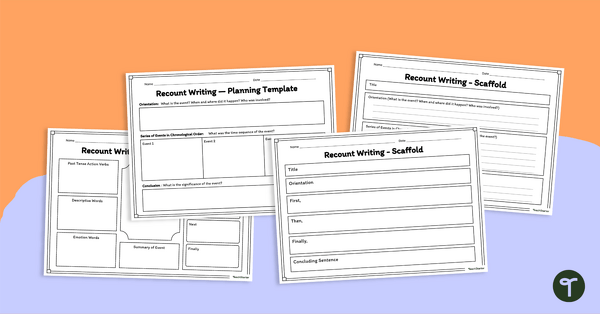
Recount Writing Planning Templates
A set of differentiated templates for students to use when planning a recount.
teaching resource
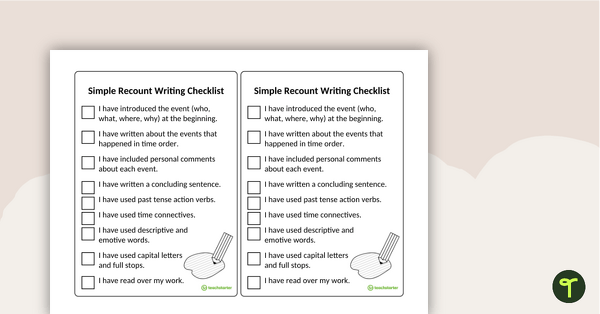
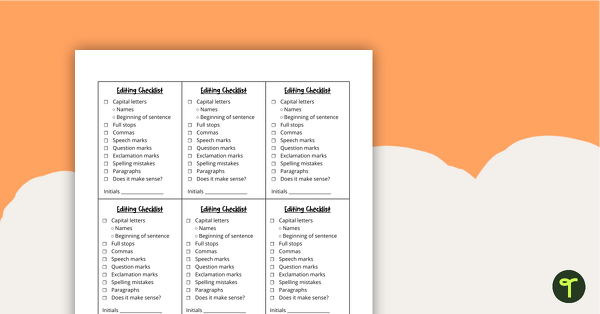
Recount Writing Checklist Pack
Use this recount writing checklist pack when teaching your students how to edit their writing.
teaching resource
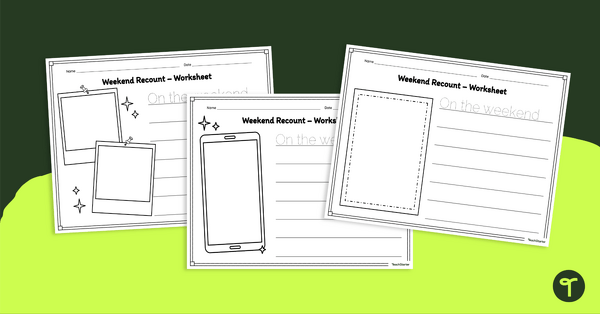
Weekend Recount Worksheets
A set of weekend recount worksheets for younger students to use when writing a weekend recount.

0 Comments
Write a review to help other teachers and parents like yourself. If you'd like to request a change to this resource, or report an error, select the corresponding tab above.