Division Teaching Resources
Make teaching division simple this school year with printable worksheets, digital activities, games and more to help students understand how to divide and apply division strategies to maths problems.
This teaching resource collection was created by the teachers on the Teach Starter team for primary teachers, and each Australian curriculum-aligned resource has been carefully reviewed and curated to ensure it's ready to use with your students! Explore long division activities, methods for explaining divisors and dividends and more, plus find differentiated resources to help you meet each student's needs!
Want to learn more about division, or looking for fresh ideas? Read on for a primer from our teacher team!
What Is Division? A Kid-Friendly Definition
Introducing division to your class? Let's start with a definition of this math operation that's easy for them to understand!
Division is the maths operation that separates a group of items or values into equal parts. The division symbols used to represent the division operation are the ÷ or / symbols. Students will also learn how to divide with a long division bracket.
An example can help students understand this!
Let's say you have 10 apples, and you want to share them equally between 2 people. To do this, you can divide 10 by 2, creating the following problem:
- 10 ÷ 2 = 5
Using division, you determine that you can give each person 5 apples.
Division Terms
Launching into division in your maths class involves plenty of new vocabulary words for your students to learn! Here are some of the terms you will want to start off with.
Dividend
The number that is being divided in a division problem is called a dividend.
Divisor
The divisor is the number that divides the dividend in a division problem.
Quotient
The answer to a division problem is called the quotient. This number represents the number of equal parts.
Remainder
The remainder in a division problem is the amount left over after dividing a dividend by the divisor that cannot be divided evenly.
Fact Family
A fact family is a set of related multiplication and division equations using the same three numbers.
Divisibility Rules
If you have a division problem where you want to know if there will be a remainder or not, these general rules will help you determine if the divisor can be divided evenly into the dividend. Some rules of divisibility include even numbers being divisible by 2, dividends that end with 0 being divisible by 10, etc.
Repeated Subtraction
What does subtraction have to do with division? This division method involves repeatedly subtracting the divisor from the dividend until the remainder or zero is reached.

A cartoon version of the division symbol
What Is Short Division?
One type of division your primary school students will learn is short division, an alternative method used for division problems with multi-digit dividends and single-digit divisors.
Short division and long division are arranged in a similar way. The only difference is that short division requires less writing than the standard algorithm. Simple subtraction and multiplication calculations are done mentally rather than writing down every step.
Short division helps students improve their maths mental skills and prepares them for learning long division. Speaking of ...
What Is Long Division?
Long division is another type of division students learn in primary school. This method is used to divide multi-digit numbers into smaller parts using a standard algorithm.
Long division looks a lot like a little house with a roof! You write the big number you want to divide inside the house, and you place the number you want to divide it by on the outside. Then you use subtraction and multiplication to figure out the answer.
What Is Division of Decimals?
Just as the name implies, division of decimals is a way to divide numbers that have a decimal point.
This maths operation works just like regular division, but you have to move the decimal point over to make the numbers easier to work with.
For example, if you want to divide 3.6 by 2, you would follow the steps of decimal division:
- Move the decimal point in 3.6 over one spot to the right to make it 36.
- Divide that by 2 to get 18.
- Move the decimal point back over one spot to get the answer of 1.8.
- Plus Plan
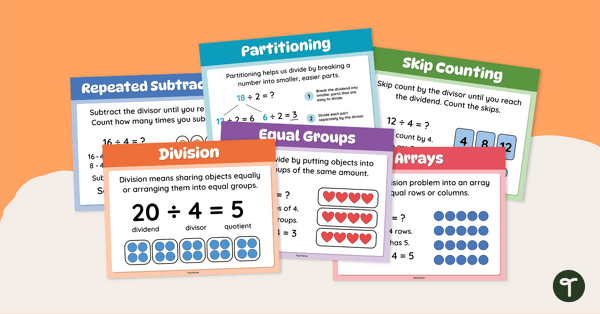
Division Strategies Poster Pack with Notebook Templates
Teach division strategies with confidence using this set of visual maths posters that help students understand division concepts through multiple problem-solving approaches.
- Plus Plan
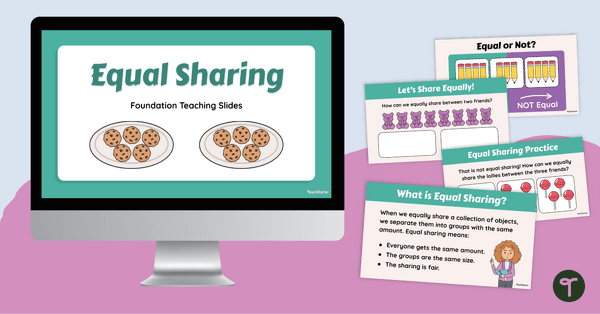
Teaching Equal Groups — Teaching Slides
Support teaching equal groups with an engaging slide deck that introduces equal sharing through visual models, classroom discussion and interactive practice.
- Plus Plan
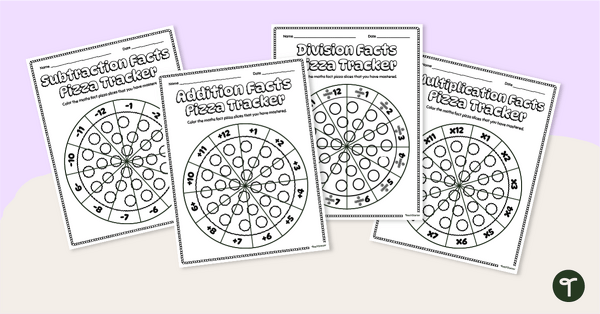
Pizza Maths Fact Fluency Trackers
Motivate and inspire students to learn their maths facts with printable maths fact fluency trackers.
- Plus Plan
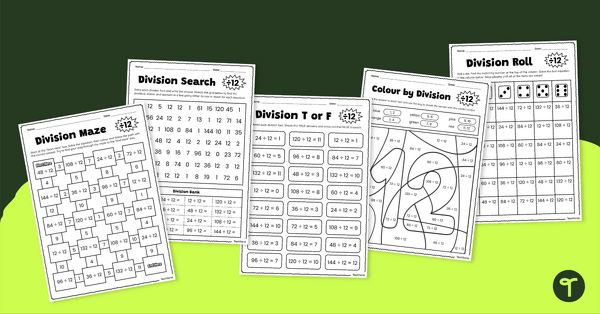
Division Fact Fluency Pack - ÷12
Practise division 12 facts with an engaging worksheet pack that helps teachers reinforce division strategies and build stronger fact recall through purposeful activities.
- Plus Plan
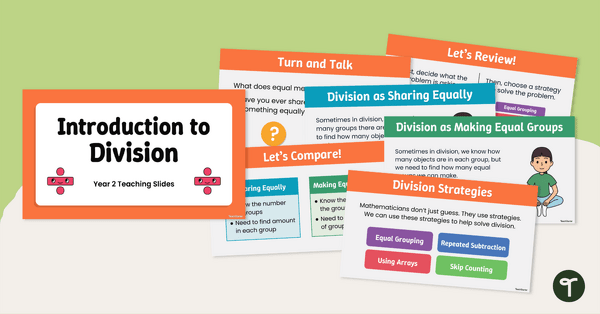
Introduction to Division Teaching Slides — Year 2
Support introduction to division lessons with engaging teaching slides that help Year 2 students understand sharing, equal groups and problem-solving strategies.
- Plus Plan
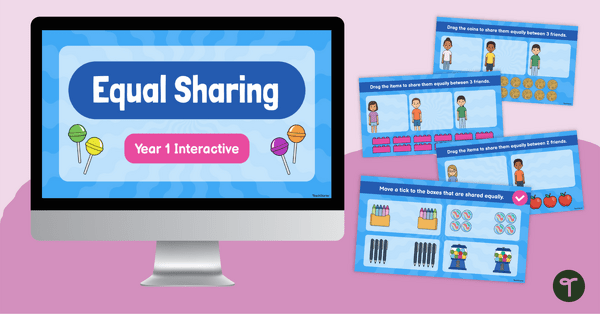
Year 1 Equal Groups Interactive
Explore Year 1 equal groups with this interactive digital activity, designed to help students build a strong foundation in grouping, sharing and early multiplication and division concepts.
- Plus Plan
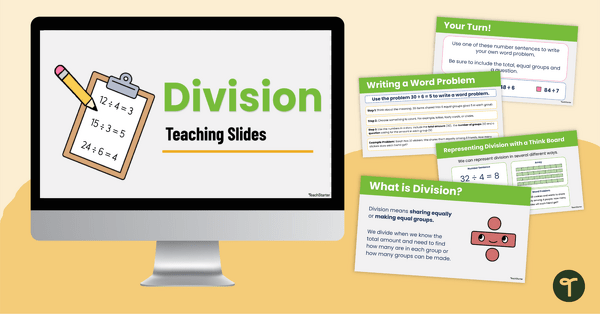
Year 3 Division Teaching Slides
Build confidence with Year 3 division using teaching slides that help students explore equal sharing, equal grouping and division word problems through engaging visual models.
- Plus Plan
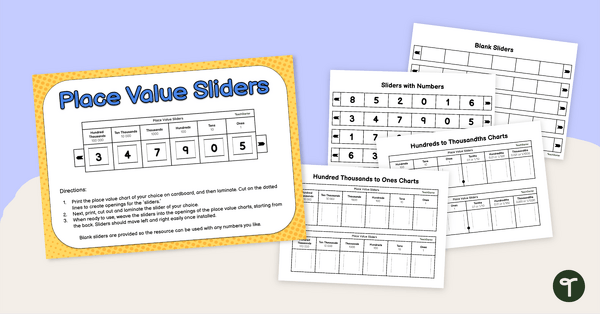
Place Value Slider Set
Break out this place value slider set for a hands-on way to demonstrate multiplying and dividing whole numbers and decimals by powers of ten.
- Plus Plan
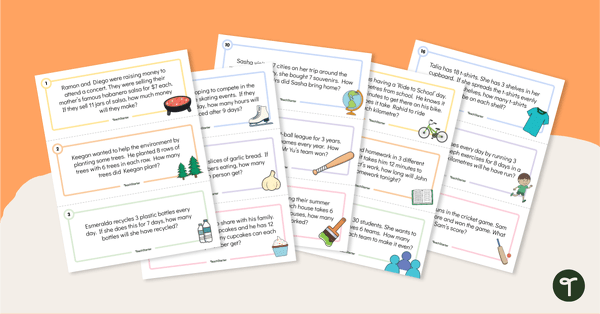
Multiplication and Division Word Problems Task Cards (Facts of 1-12)
Use a range of strategies to solve multiplication and division problems for times tables facts 1-12.
- Plus Plan
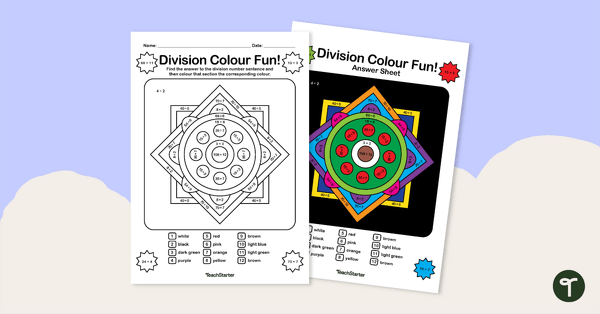
Colour by Number - Mixed 1 - 12 Division
Make times tables practice more engaging with this division colour by number worksheet, designed to strengthen division fact fluency while giving students a fun, self-checking maths activity.
- Plus Plan
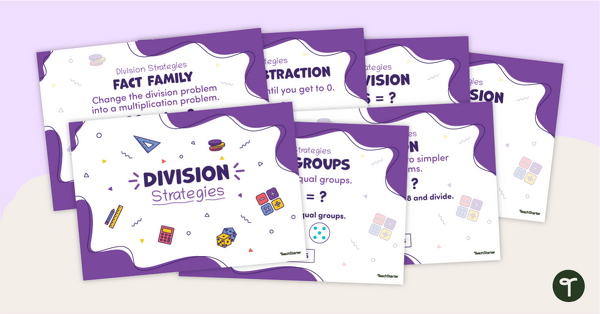
Division Strategies Posters
Use this set of printable classroom posters when teaching different division strategies.
- Plus Plan
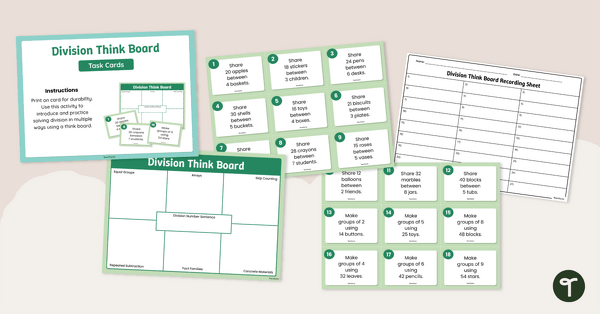
Year 2 Division Think Board
Use a division think board to help students solve division problems in multiple ways while building conceptual understanding and mathematical confidence.
- Plus Plan
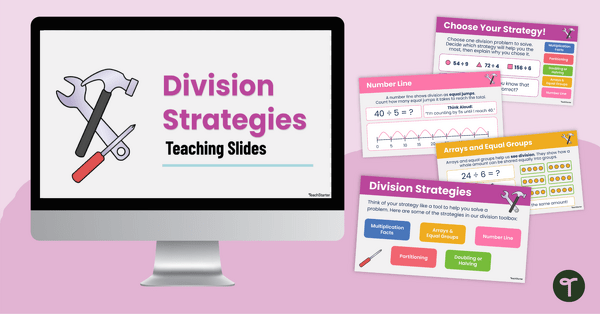
Division Strategies Teaching Slides
Explore division strategies with these interactive teaching slides that help Year 4 students solve division problems, choose efficient methods and explain their mathematical thinking.
- Plus Plan
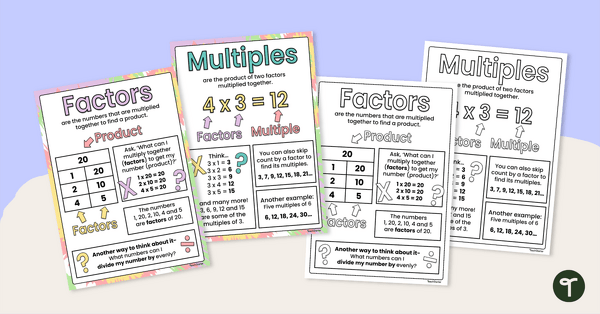
Factors and Multiples Anchor Chart Set
Hang the posters in our factors and multiples anchor chart set up in your classroom to give your students an easy-to-understand reference.
- Plus Plan
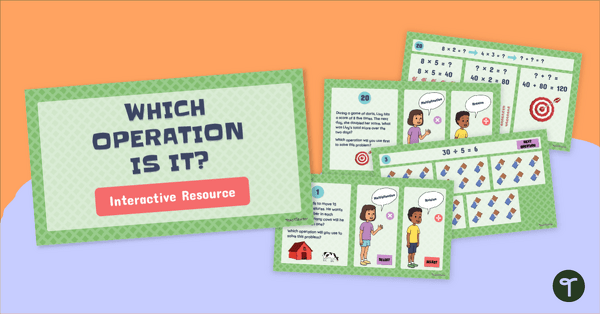
Multiply and Divide! Word Problems Interactive
Practise solving one and two step worded maths problems and have fun with our Multiply and Divide Word Problems Interactive Activity.
- Plus Plan
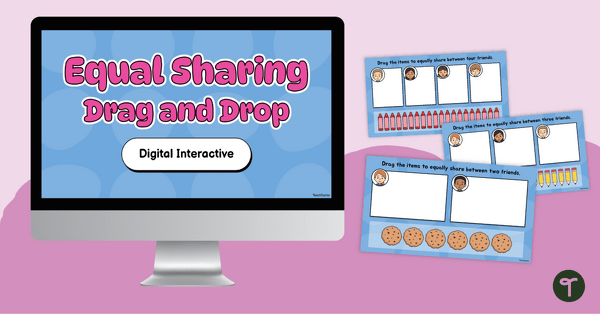
Making Equal Groups Interactive Drag and Drop
Use this making equal groups interactive resource to help students build early division understanding.
- Plus Plan
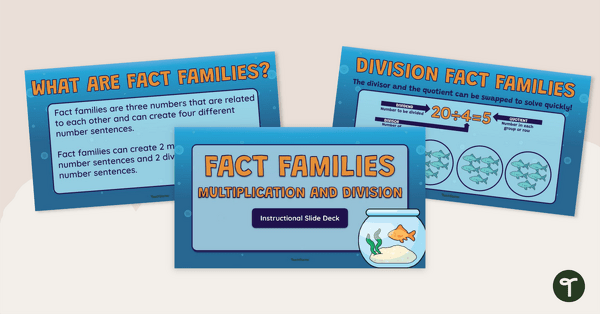
Multiplication and Division Fact Families Teaching Slides
Introduce multiplication and division fact families to your students with this 36-slide teaching slide deck.
- Plus Plan
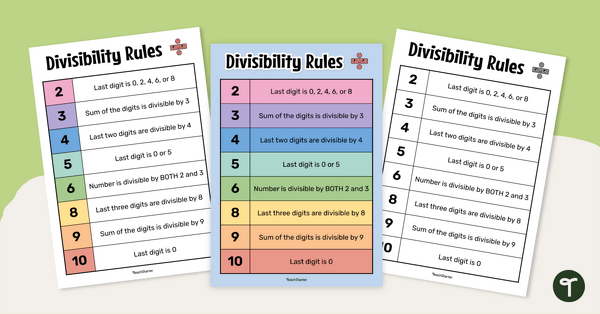
Divisibility Rules Chart
Hang our Divisibility Rules Chart in your classroom to give students a quick and easy reference for the rules of divisibility.
- Plus Plan
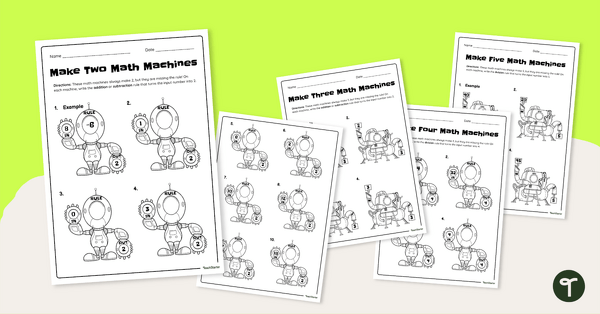
Input Output Machine Worksheet Set
Use this input output machine worksheet set to introduce your students to number patterns while giving them computational practice.
- Plus Plan
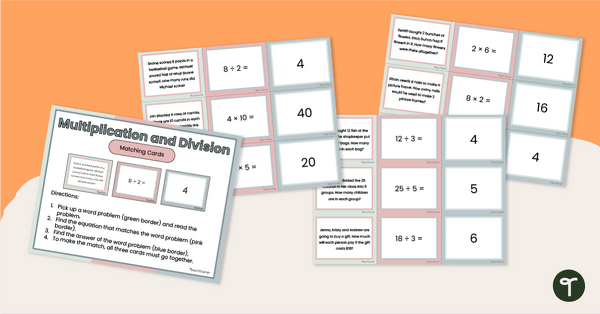
Basic Multiplication and Division Word Problems - Matching Game
Practice reading, writing, and solving basic multiplication and division word problems with a matching activity.
- Plus Plan
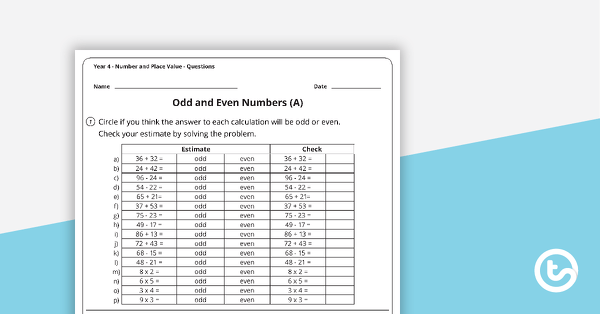
Number and Place Value Worksheets - Year 4
14 number and place value worksheets linked to the Australian Curriculum.
- Plus Plan
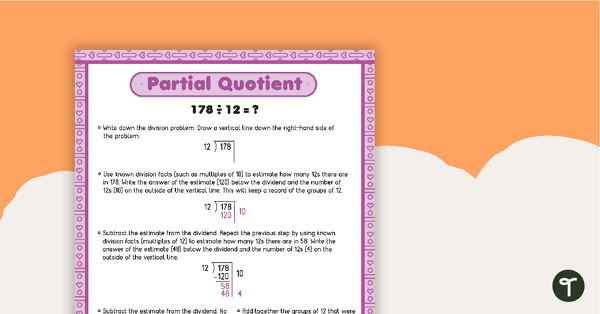
Long Division Strategy Posters
Use this set of 4 posters when teaching different long division strategies.
- Plus Plan
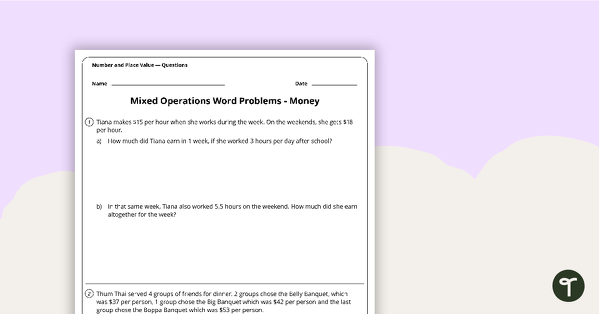
Word Problem Worksheets - Year 5 and Year 6
4 mixed operations word problem worksheets with answers.
- Plus Plan
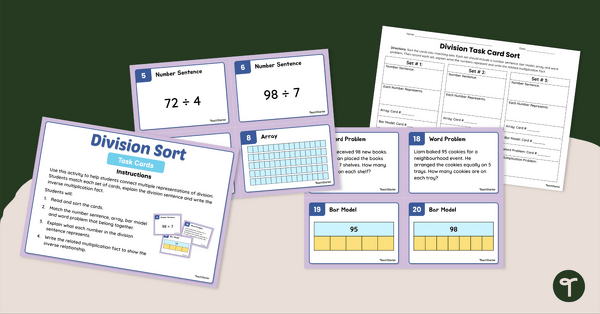
Year 4 Division Task Cards — Solve and Sort
Build understanding with division task cards that help Year 4 students connect division equations, arrays, bar models and word problems through a hands-on sorting activity.
- Plus Plan
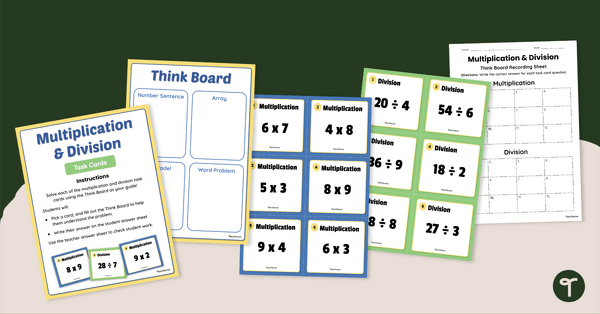
Year 3 Multiplication and Division Think Board
Use this division think board resource to help Year 3 students build a deeper understanding of multiplication and division strategies.
- Plus Plan
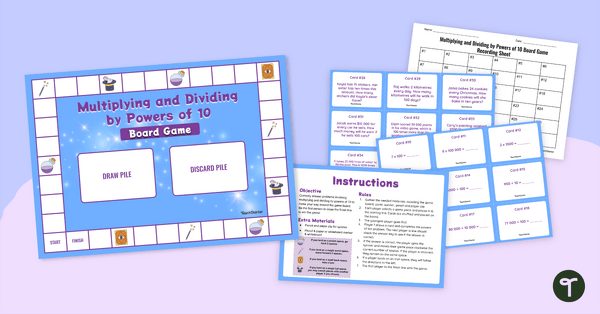
Multiplying and Dividing by Powers of 10 Game
Play this multiplying and dividing by powers of 10 game to give students practice multiplying and dividing whole numbers by 10, 100 and 1000.
- Plus Plan
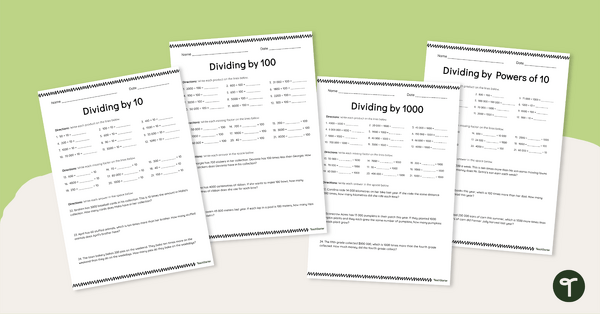
Dividing by Powers of 10 Worksheet Set
Utilise this dividing by powers of 10 worksheet set to give your students practise dividing whole numbers by 10, 100 and 1000.
- Plus Plan
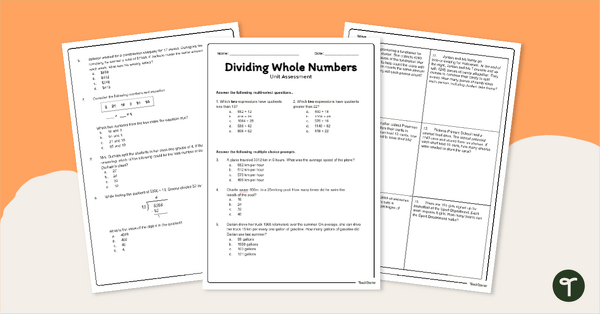
Year 4 Long Division Test (No Remainders)
Assess your students' skills with long division using a printable Year 4 Long Division Test.
- Plus Plan
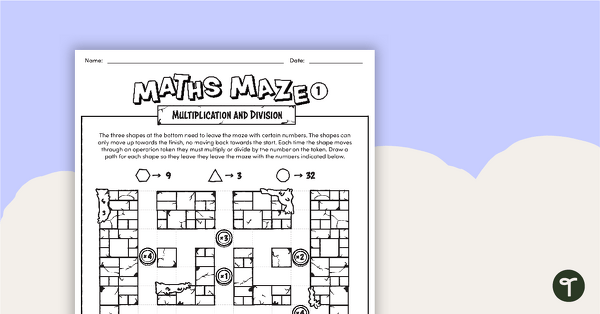
Maths Mazes (Multiplication and Division)
Solve these mazes by manipulating numbers using multiplication and division skills.
- Plus Plan
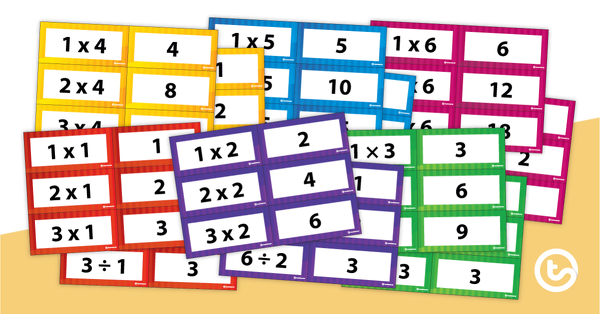
Multiplication and Division Facts Flashcards - Complete Set
Build multiplication and division confidence with this set of times tables flashcards, featuring fact families for the 1-12 times tables to support maths fact fluency and automatic recall.
- Plus Plan
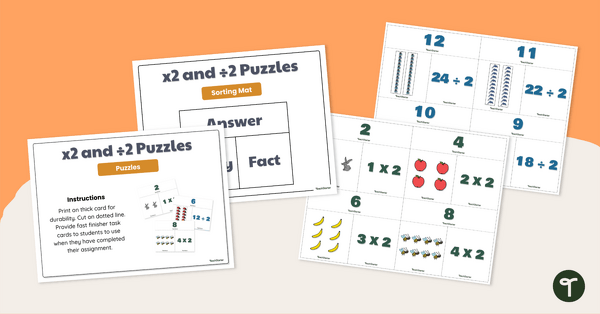
Multiplication and Division Puzzles
Incorporate multiplication and division puzzles that help students build fluency with the 2× facts and related ÷2 facts.
- Plus Plan
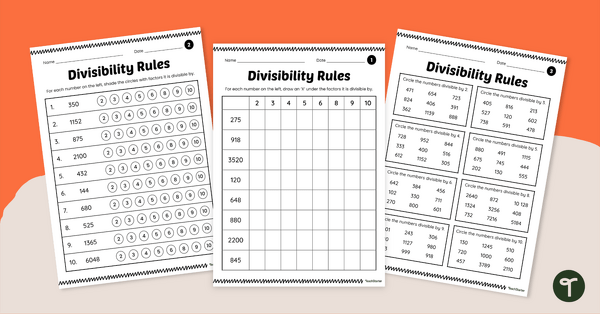
Divisibility Rules Worksheet Set
Use this divisibility rules worksheet set to give your students varied practice finding the factors of given numbers.