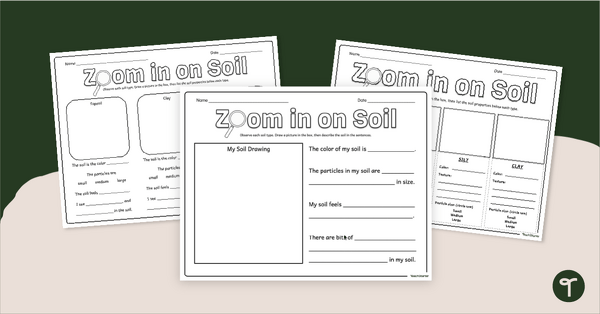
Transform your students into soil detectives as they explore the color, texture and particle size of various soil types.
Explore the Types of Soil
Did you know that there are four main types of soil?
The four main types of soil are sand, loam, silt and clay. Each of these soil types has its own unique characteristics, including color, texture and particle size.
This simple soil observation worksheet has been designed by our experienced team of teachers to help you transform your primary school students into soil detectives! To complete the worksheet, the students are required to carefully observe samples of each soil type. They must then draw a picture of each sample in the provided boxes and comment on each soil’s properties. The soil properties addressed in this worksheet are:
- Color
- Texture
- Particle size (small, medium or large)
This soil worksheet is available for download as a black-and-white PDF or an editable Google Slides file.
We have included three variations of this resource for students of different age and ability levels.
Further Soil Science Experiment Ideas
This soil observation worksheet provides a great springboard for further exploration into soil types and their properties. If you’re looking to further extend your exploration into soil types and their properties, why not try some of the following activities:
- Texture Test – This is a great activity for further developing students’ understanding of the varying particle sizes among the four main soil types. Using a sample of each soil type, have the students compare how easily each type of soil can be formed into a ball. Soil types with smaller particles (such as clay) will form a ball much more easily than those with larger particles (such as sand).
- Erosion Simulation – This is a great activity to further develop students’ understanding of how well each soil type retains water. Create a mini landscape in a tray using different types of soil. Use a spray bottle to simulate rainfall and observe how each soil type responds to erosion. Soil types with smaller particles will experience minimal erosion, while those with larger particles will erode more easily.
- Plant Growth Experiment – This is a great activity for observing the fertility of different soil types. Plant the same type of seeds in different pots filled with different soil types, then observe and record the plants’ growth rate and health over a few weeks. Discuss how the soil composition of each soil type affected the plant growth.
Download This Types of Soil Worksheet
Use the Download button above to access either the printable PDF or the editable Google Slides version of this resource. (Note: You will be prompted to make a copy of the Google Slides template before accessing it).
This resource was created by Kaitlyn Blevins, a teacher in Georgia and a Teach Starter collaborator.
More Soil Activities for Elementary Students
Looking for more activities to enhance your science lessons on soil? Explore this great selection of teacher-created resources!
[resource:4817250] [resource:5003237] [resource:4995359]

0 Comments
Write a review to help other teachers and parents like yourself. If you'd like to request a change to this resource, or report an error, select the corresponding tab above.