Year 6
The proficiency strands understanding, fluency, problem-solving and reasoning are an integral part of mathematics content across the three content strands: number and algebra, measurement and geometry, and statistics and probability. The proficiencies reinforce the significance of working mathematically within the content and describe how the content is explored or developed. They provide the language to build in the developmental aspects of the learning of mathematics. The achievement standards reflect the content and encompass the proficiencies.
At this year level:
- understanding includes describing properties of different sets of numbers, using fractions and decimals to describe probabilities, representing fractions and decimals in various ways and describing connections between them, and making reasonable estimations
- fluency includes representing integers on a number line, calculating simple percentages, using brackets appropriately, converting between fractions and decimals, using operations with fractions, decimals and percentages, measuring using metric units and interpreting timetables
- problem-solving includes formulating and solving authentic problems using fractions, decimals, percentages and measurements, interpreting secondary data displays and finding the size of unknown angles
- reasoning includes explaining mental strategies for performing calculations, describing results for continuing number sequences, explaining the transformation of one shape into another and explaining why the actual results of chance experiments may differ from expected results.
(source: www.australiancurriculum.edu.au)
Achievement Standard
By the end of Year 6, students recognise the properties of prime, composite, square and triangular numbers. They describe the use of integers in everyday contexts. They solve problems involving all four operations with whole numbers. Students connect fractions, decimals and percentages as different representations of the same number. They solve problems involving the addition and subtraction of related fractions. Students make connections between the powers of 10 and the multiplication and division of decimals. They describe rules used in sequences involving whole numbers, fractions and decimals. Students connect decimal representations to the metric system and choose appropriate units of measurement to perform a calculation. They make connections between capacity and volume. They solve problems involving length and area. They interpret timetables. Students describe combinations of transformations. They solve problems using the properties of angles. Students compare observed and expected frequencies. They interpret and compare a variety of data displays including those displays for two categorical variables. They interpret secondary data displayed in the media.
Students locate fractions and integers on a number line. They calculate a simple fraction of a quantity. They add, subtract and multiply decimals and divide decimals where the result is rational. Students calculate common percentage discounts on sale items. They write correct number sentences using brackets and order of operations. Students locate an ordered pair in any one of the four quadrants on the Cartesian plane. They construct simple prisms and pyramids. Students describe probabilities using simple fractions, decimals and percentages.
(source: www.australiancurriculum.edu.au)
- Plus Plan
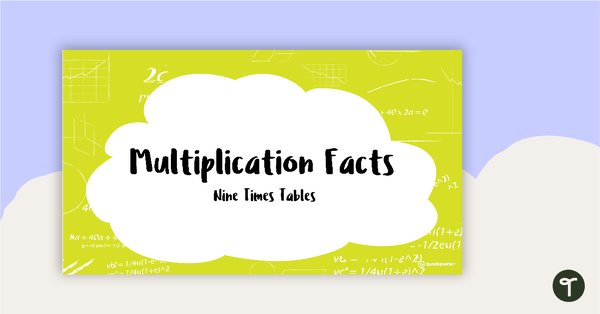
Multiplication Facts PowerPoint - Nine Times Tables
A 30 slide PowerPoint to use when learning about multiplication.
- Plus Plan
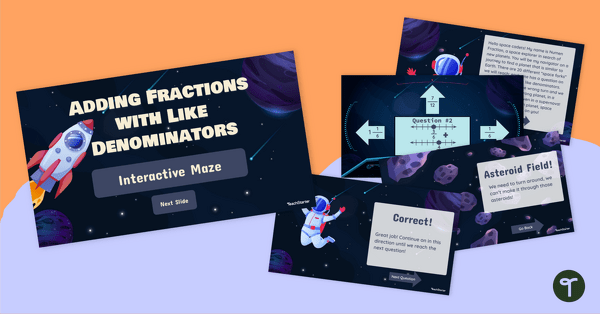
Adding Fractions With Like Denominators Interactive Maze
Get your students to add like fractions to find their way out of a space-themed digital maze!
- Plus Plan
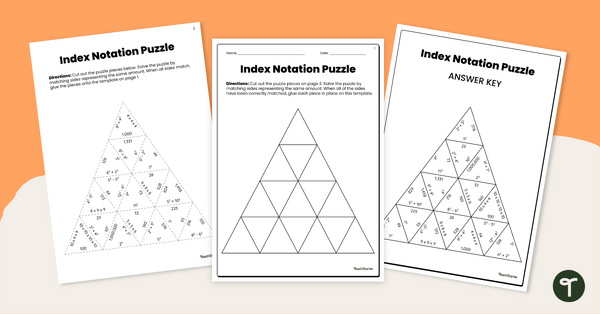
Index Notation Worksheet — Tarsia Puzzle
Share this index notation worksheet with your students to give them practice evaluating exponential expressions in a fun puzzle format.
- Free Plan
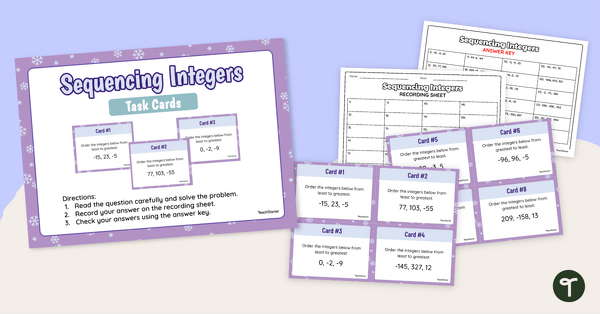
Ordering Integers Activity — Task Cards
Introduce this ordering integers activity to your students to give them experience ordering positive and negative numbers.
- Plus Plan
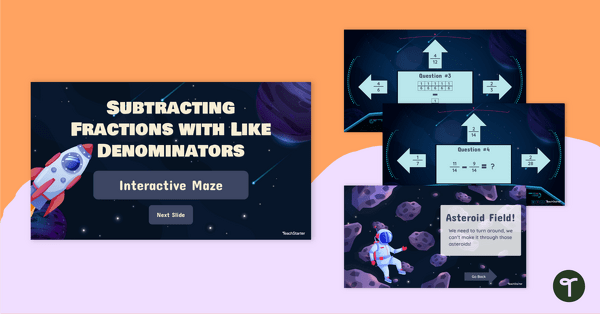
Subtracting Fractions With Like Denominators Interactive Maze
Get your students to subtract like fractions to find their way out of a space-themed digital maze!
- Plus Plan
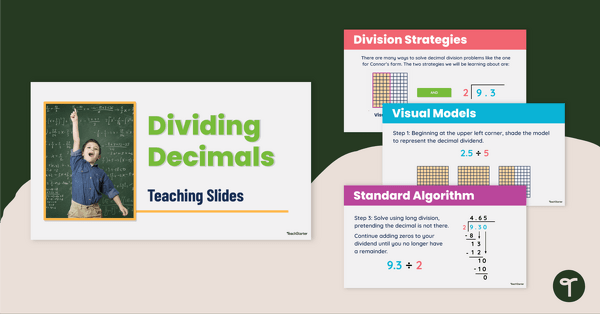
Dividing Decimals by Whole Numbers Teaching Slides
Teach your students how to divide decimals by whole numbers using visual models and the standard algorithm using this step-by-step teaching presentation.
- Plus Plan
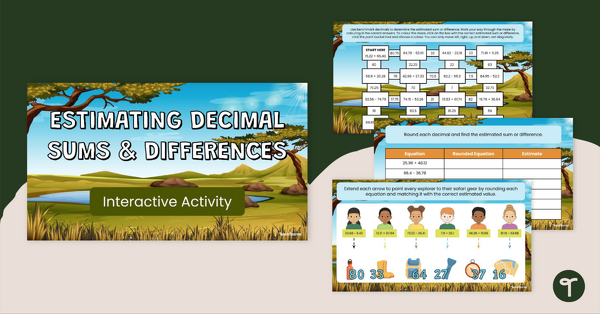
Estimating Decimal Sums and Differences Interactive Activity
Take your students on a safari adventure while practicing how to estimate decimal sums and differences with this interactive activity.
- Plus Plan
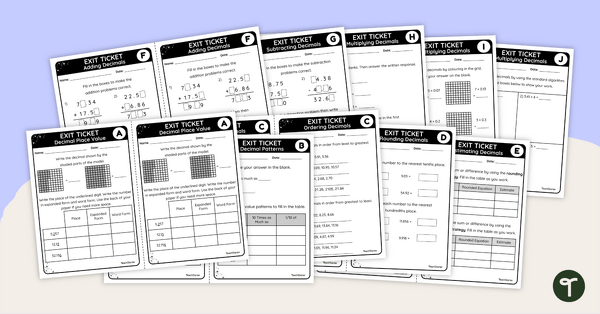
Decimal Exit Tickets (Place Value, Rounding, Ordering and Computation)
Assess student understanding of decimal place value, rounding, ordering and computation with this set of 21 exit tickets.
- Plus Plan
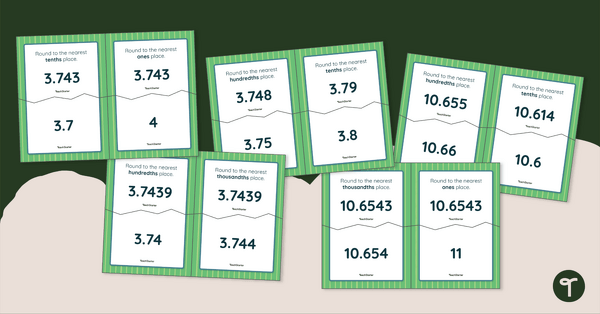
It's a Match! – Rounding With Decimals Puzzle
Practise rounding decimals up to the thousandths place with 34 puzzle pair matching pieces.
- Plus Plan
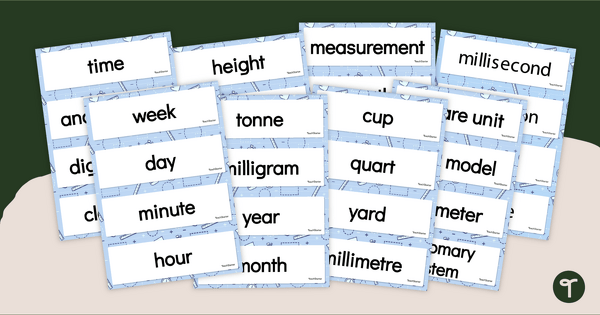
Units of Measurement Word Wall Vocabulary
Print a pack of measurement vocabulary cards to help your students review academic vocabulary.
- Plus Plan
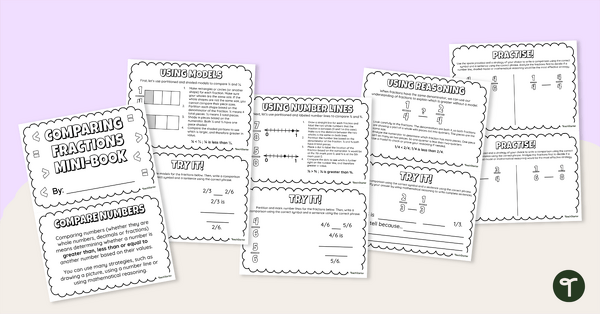
Comparing Fractions Mini-Book
Use this mini-book to help your students learn how to compare fractions with visual models, number lines and mathematical reasoning.
- Plus Plan
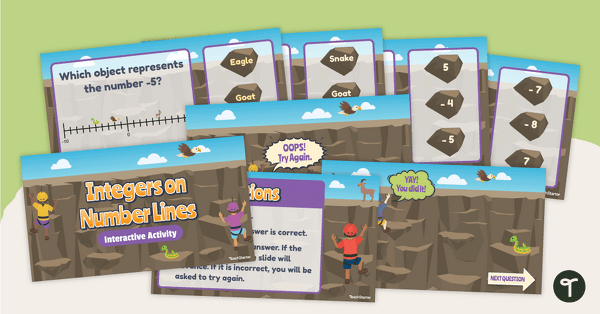
Integers on Number Lines - Interactive Task Cards
Teach your students to locate positive and negative integers on a number line with a Google Slides interactive number line activity.
- Plus Plan
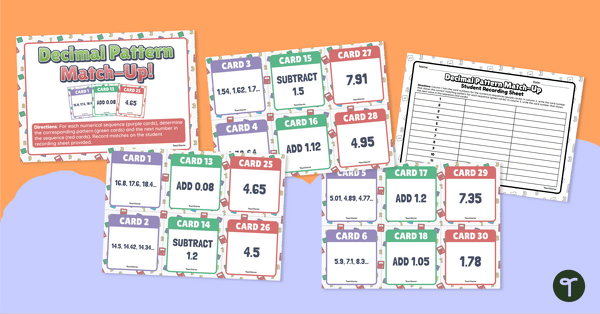
Decimal Patterns Match-Up Activity
Use this match-up activity to determine patterns and extend numerical sequences by adding and subtracting decimals.
- Free Plan
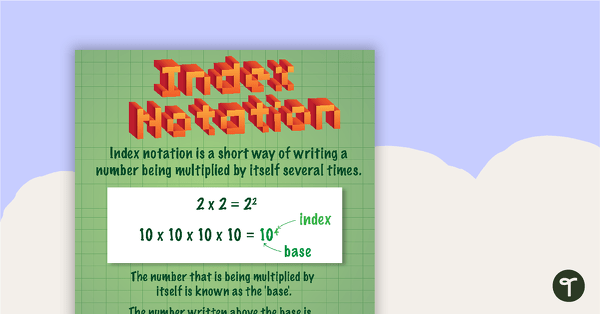
Index Notation Poster
A poster explaining index notation.
- Plus Plan
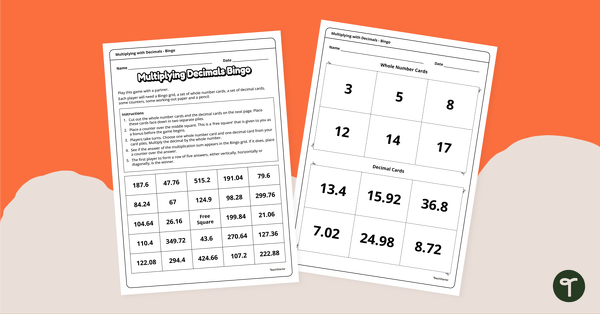
Multiplying with Decimals Bingo Game
Get your students multiplying decimals by whole numbers with this engaging Bingo game.
- Plus Plan
Multiplication Facts PowerPoint - One Times Tables
A 30 slide PowerPoint to use when learning about multiplication.
- Plus Plan
Fractions Resource Pack
A collection of resources exploring fractions.