Represents and compares halves, quarters, thirds and fifths as lengths on a number line and their related fractions formed by halving (eighths, sixths and tenths)
Interpret unmarked and partial units when measuring and comparing attributes of length, mass, capacity, duration and temperature, using scaled and digital instruments and appropriate units
Estimate and compare angles using angle names including acute, obtuse, straight angle, reflex and revolution, and recognise their relationship to a right angle
Acquire data for categorical and discrete numerical variables to address a question of interest or purpose using digital tools; represent data using many-to-one pictographs, column graphs and other displays or visualisations; interpret and discuss the information that has been created
Analyse the effectiveness of different displays or visualisations in illustrating and comparing data distributions, then discuss the shape of distributions and the variation in the data
Conduct statistical investigations, collecting data through survey responses and other methods; record and display data using digital tools; interpret the data and communicate the results
Use mathematical modelling to solve practical problems involving additive and multiplicative situations including financial contexts; formulate the problems using number sentences and choose efficient calculation strategies, using digital tools where appropriate; interpret and communicate solutions
Develop efficient strategies and use appropriate digital tools for solving problems involving addition and subtraction, and multiplication and division where there is no remainder
Recognise and extend the application of place value to tenths and hundredths and use the conventions of decimal notation to name and represent decimals
Describe possible everyday events and the possible outcomes of chance experiments and order outcomes or events based on their likelihood of occurring; identify independent or dependent events
Conduct statistical investigations, collecting data through survey responses and other methods; record and display data using digital tools; interpret the data and communicate the results
Analyse the effectiveness of different displays or visualisations in illustrating and comparing data distributions, then discuss the shape of distributions and the variation in the data
Acquire data for categorical and discrete numerical variables to address a question of interest or purpose using digital tools; represent data using many-to-one pictographs, column graphs and other displays or visualisations; interpret and discu...
Estimate and compare angles using angle names including acute, obtuse, straight angle, reflex and revolution, and recognise their relationship to a right angle
Use scaled and digital instruments to interpret unmarked and partial units to measure and compare lengths, masses, capacities, durations and temperatures, using appropriate units
Recall and demonstrate proficiency with multiplication facts up to 10 × 10 and related division facts, and explain the patterns in these; extend and apply facts to develop efficient mental and written strategies for computation with larger numb...
Follow and create algorithms involving a sequence of steps and decisions that use addition or multiplication to generate sets of numbers; identify and describe any emerging patterns
Use mathematical modelling to solve practical problems that involve additive and multiplicative situations, including financial contexts; formulate the problems using number sentences and choose efficient calculation strategies, using digital to...
Develop efficient mental and written strategies and use appropriate digital tools for solving problems involving addition and subtraction, and multiplication and division where there is no remainder
Recognise and extend the application of place value to tenths and hundredths and use the conventions of decimal notation to name and represent decimals
Construct suitable data displays, with and without the use of digital technologies, from given or collected data. Include tables, column graphs and picture graphs where one picture can represent many data values
Find unknown quantities in number sentences involving addition and subtraction and identify equivalent number sentences involving addition and subtraction
Develop efficient mental and written strategies and use appropriate digital technologies for multiplication and for division where there is no remainder
Recall multiplication facts up to 10 x 10 and related division facts
Elaborations
using known multiplication facts to calculate related division facts (Skills: Numeracy, Critical and Creative Thinking)
View this topic on www.australiancurr...
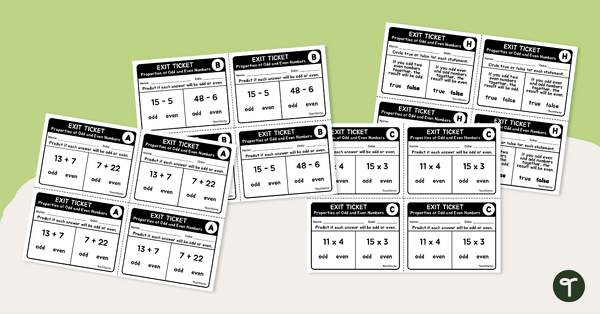
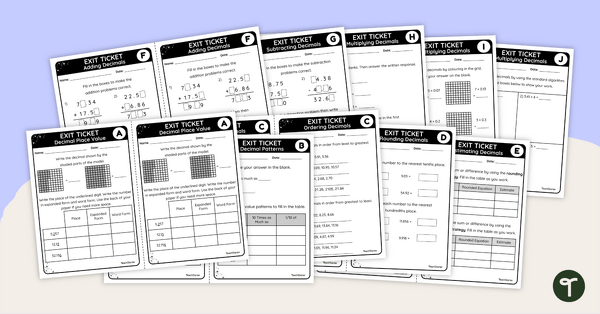
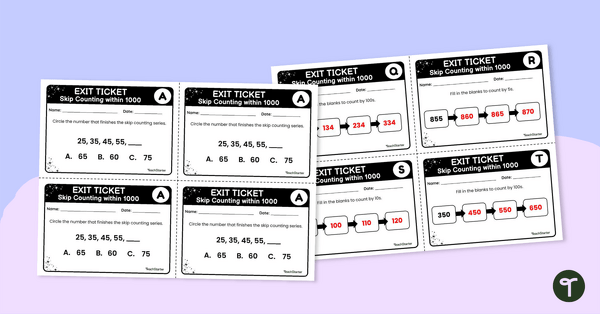
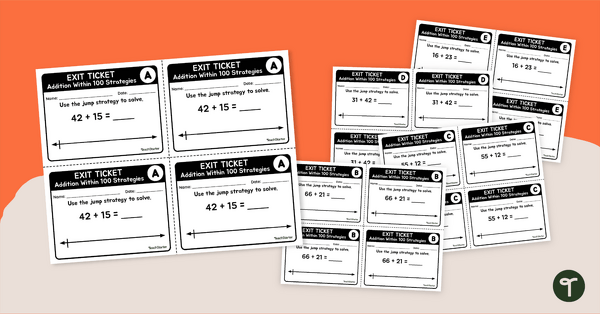
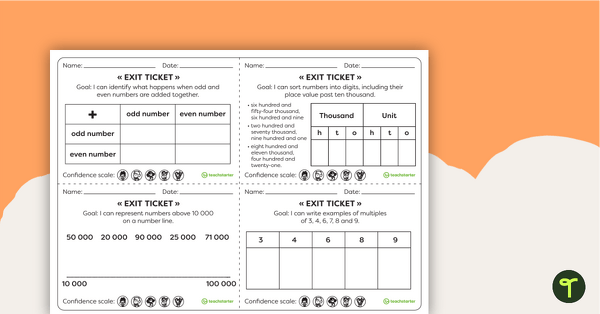
24 Numeracy Exit Ticket activities for students to provide evidence of their learning progress.
This teaching resource is an assessment tool for students to show evidence of their learning. Use Exit Tickets after a numeracy skill has been taught to show evidence that they have acquired the skill and are ready to move to the next learning goal.
These Numeracy Exit tickets collect evidence for basic Year 4 curriculum requirements. Use the editable Word version to create your own class-specific learning goals.
Represents and compares halves, quarters, thirds and fifths as lengths on a number line and their related fractions formed by halving (eighths, sixths and tenths)
Interpret unmarked and partial units when measuring and comparing attributes of length, mass, capacity, duration and temperature, using scaled and digital instruments and appropriate units
Estimate and compare angles using angle names including acute, obtuse, straight angle, reflex and revolution, and recognise their relationship to a right angle
Acquire data for categorical and discrete numerical variables to address a question of interest or purpose using digital tools; represent data using many-to-one pictographs, column graphs and other displays or visualisations; interpret and discuss the information that has been created
Analyse the effectiveness of different displays or visualisations in illustrating and comparing data distributions, then discuss the shape of distributions and the variation in the data
Conduct statistical investigations, collecting data through survey responses and other methods; record and display data using digital tools; interpret the data and communicate the results
Use mathematical modelling to solve practical problems involving additive and multiplicative situations including financial contexts; formulate the problems using number sentences and choose efficient calculation strategies, using digital tools where appropriate; interpret and communicate solutions
Develop efficient strategies and use appropriate digital tools for solving problems involving addition and subtraction, and multiplication and division where there is no remainder
Recognise and extend the application of place value to tenths and hundredths and use the conventions of decimal notation to name and represent decimals
Describe possible everyday events and the possible outcomes of chance experiments and order outcomes or events based on their likelihood of occurring; identify independent or dependent events
Conduct statistical investigations, collecting data through survey responses and other methods; record and display data using digital tools; interpret the data and communicate the results
Analyse the effectiveness of different displays or visualisations in illustrating and comparing data distributions, then discuss the shape of distributions and the variation in the data
Acquire data for categorical and discrete numerical variables to address a question of interest or purpose using digital tools; represent data using many-to-one pictographs, column graphs and other displays or visualisations; interpret and discu...
Estimate and compare angles using angle names including acute, obtuse, straight angle, reflex and revolution, and recognise their relationship to a right angle
Use scaled and digital instruments to interpret unmarked and partial units to measure and compare lengths, masses, capacities, durations and temperatures, using appropriate units
Recall and demonstrate proficiency with multiplication facts up to 10 × 10 and related division facts, and explain the patterns in these; extend and apply facts to develop efficient mental and written strategies for computation with larger numb...
Follow and create algorithms involving a sequence of steps and decisions that use addition or multiplication to generate sets of numbers; identify and describe any emerging patterns
Use mathematical modelling to solve practical problems that involve additive and multiplicative situations, including financial contexts; formulate the problems using number sentences and choose efficient calculation strategies, using digital to...
Develop efficient mental and written strategies and use appropriate digital tools for solving problems involving addition and subtraction, and multiplication and division where there is no remainder
Recognise and extend the application of place value to tenths and hundredths and use the conventions of decimal notation to name and represent decimals
Construct suitable data displays, with and without the use of digital technologies, from given or collected data. Include tables, column graphs and picture graphs where one picture can represent many data values
Find unknown quantities in number sentences involving addition and subtraction and identify equivalent number sentences involving addition and subtraction
Develop efficient mental and written strategies and use appropriate digital technologies for multiplication and for division where there is no remainder
Recall multiplication facts up to 10 x 10 and related division facts
Elaborations
using known multiplication facts to calculate related division facts (Skills: Numeracy, Critical and Creative Thinking)
View this topic on www.australiancurr...
Recognise, represent and order numbers to at least tens of thousands
Teach Starter Publishing
We create premium quality, downloadable teaching resources for primary/elementary school teachers that make classrooms buzz!
14 Comments
Write a review to help other teachers and parents like yourself. If you'd like to
request a change to this resource, or report an error, select the corresponding tab
above.
There is an error on page 2 - I can match equivalent fractions. 4/12 and 2/3 are not equivalent to any of the representations.
Stephanie (Teach Starter)
·
Hi there Jenny, thank you so much for taking the time to point out this error. I have changed 2/3 to 1/3 on the resource so this fraction now has equivalence with 4/12. This new version is available to download from the resource page. Thanks again, and have a wonderful day!
Tara Bowden
·
These are great. Is it possible to produce a copy which has each exit ticket on a separate page with 4 copies of it?
Annabel
·
Great idea!!
Tom (Teach Starter)
·
Hi Tara,
Thank you for your comment! So we can keep all of our suggestions and requests together, can you please submit a change request to this resource using the Changes & Updates tab above? This tab can be found near the comments section.
Thanks again!
A learning goal has been updated to now say, 'I can represent numbers above 10 000 on a number line.'
Suggest a Change
Would you like something changed or customised on this resource? While our team
makes every effort to complete change suggestions, we can't guarantee that every
change will be completed.
There is an error on page 2 - I can match equivalent fractions. 4/12 and 2/3 are not equivalent to any of the representations.
Hi there Jenny, thank you so much for taking the time to point out this error. I have changed 2/3 to 1/3 on the resource so this fraction now has equivalence with 4/12. This new version is available to download from the resource page. Thanks again, and have a wonderful day!
These are great. Is it possible to produce a copy which has each exit ticket on a separate page with 4 copies of it?
Great idea!!
Hi Tara, Thank you for your comment! So we can keep all of our suggestions and requests together, can you please submit a change request to this resource using the Changes & Updates tab above? This tab can be found near the comments section. Thanks again!