A worksheet for students to practice representing number 1–20 using numbers, words, and tally marks.
Use this resource when students are learning to represent numbers 1–20 using numbers, words, and tally marks.
Updated: 05 Nov 2020
A worksheet for students to practice representing number 1–20 using numbers, words, and tally marks.
Non-Editable: PDF
Pages: 1 Page
Grades: K - 1
Understand the relationship between numbers and quantities; connect counting to cardinality.
When counting objects, say the number names in the standard order, pairing each object with one and only one number name and each number name with one and only one object.
Understand that the last number name said tells the number of objects counted. The number of objects is the same regardless of their arrangement or the order in which they were counted.
Count to 120, starting at any number less than 120. In this range, read and write numerals and represent a number of objects with a written numeral.
Read, write, and represent whole numbers from 0 to at least 20 with and without objects or pictures;
Count a set of objects up to at least 20 and demonstrate that the last number said tells the number of objects in the set regardless of their arrangement or order;
Use objects, pictures, and expanded and standard forms to represent numbers up to 120;
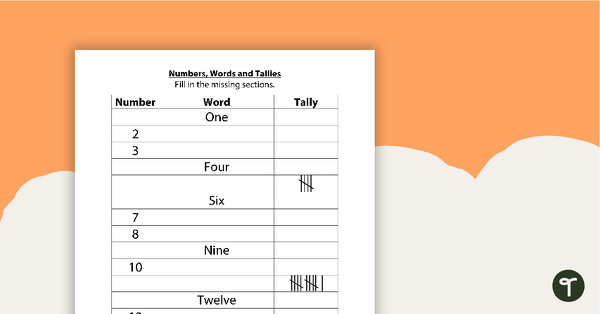
A worksheet for students to practice representing number 1–20 using numbers, words, and tally marks.
Use this resource when students are learning to represent numbers 1–20 using numbers, words, and tally marks.
Understand the relationship between numbers and quantities; connect counting to cardinality.
When counting objects, say the number names in the standard order, pairing each object with one and only one number name and each number name with one and only one object.
Understand that the last number name said tells the number of objects counted. The number of objects is the same regardless of their arrangement or the order in which they were counted.
Count to 120, starting at any number less than 120. In this range, read and write numerals and represent a number of objects with a written numeral.
Read, write, and represent whole numbers from 0 to at least 20 with and without objects or pictures;
Count a set of objects up to at least 20 and demonstrate that the last number said tells the number of objects in the set regardless of their arrangement or order;
Use objects, pictures, and expanded and standard forms to represent numbers up to 120;

We create premium quality, downloadable teaching resources for primary/elementary school teachers that make classrooms buzz!
Would you like something changed or customised on this resource? While our team makes every effort to complete change suggestions, we can't guarantee that every change will be completed.
Did you spot an error on this resource? Please let us know and we will fix it shortly.
Are you having trouble downloading or viewing this resource? Please try the following steps:
If you are still having difficulty, please visit the Teach Starter Help Desk or contact us .
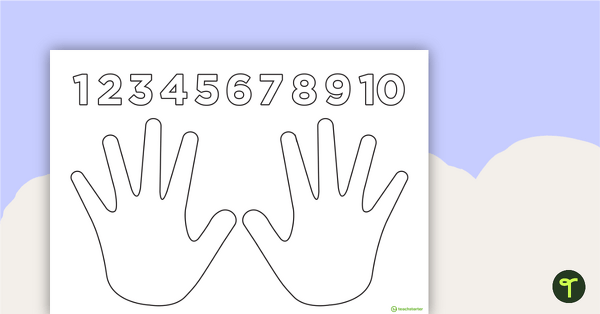
Teach counting from 1 to 10 and one-to-one correspondence with a creative (and free) printable activity for preschool, kindergarten, or 1st grade.
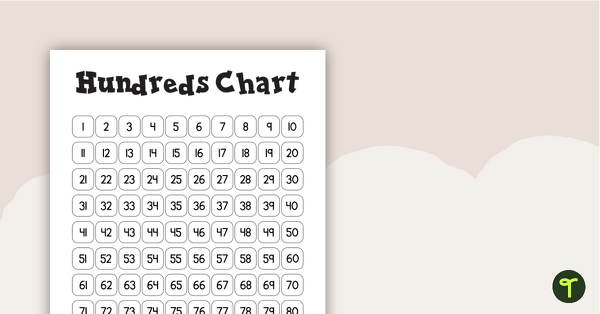
A black and white hundreds chart that can be used in a variety of ways.
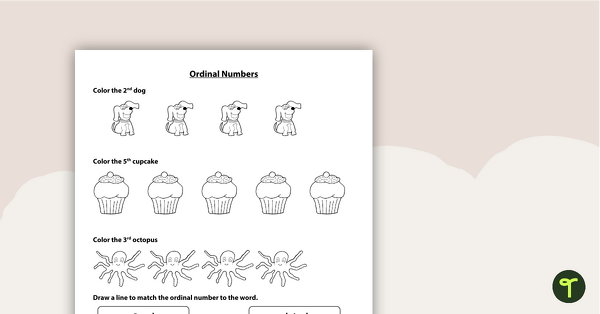
A worksheet to help students practice working with ordinal numbers.
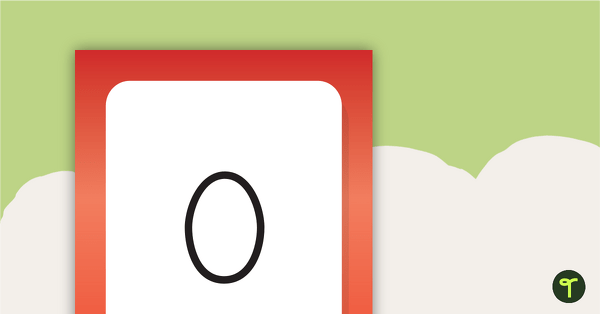
Posters showing 0–30 in standard and word form.
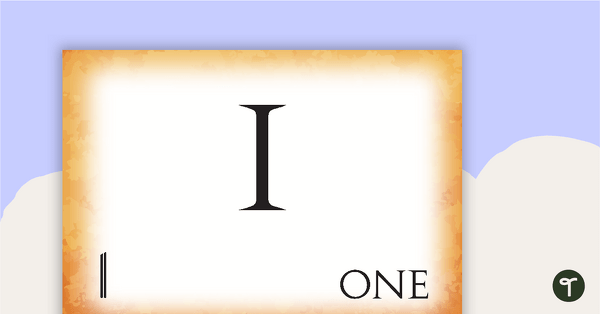
A set of posters showing different Roman numerals and their values.
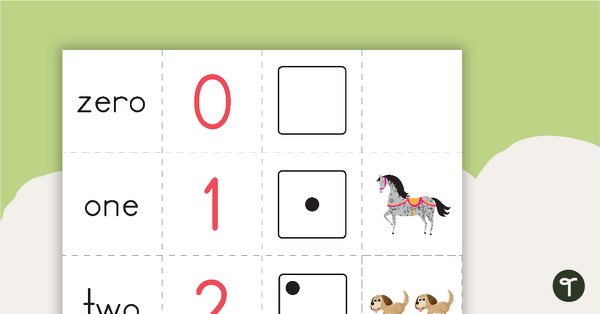
Match different representations of numbers 0 to 20.
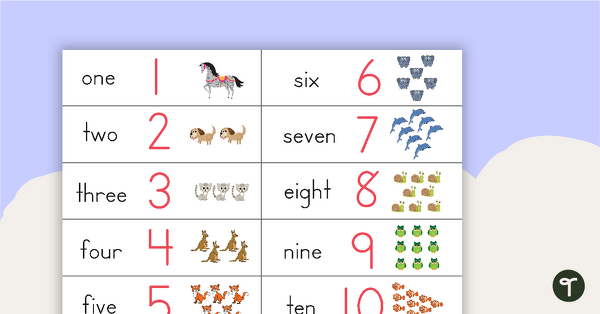
A poster of numbers in different forms.
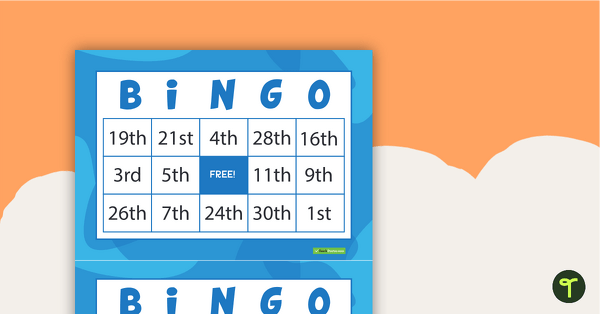
A set of 32 bingo cards to practice ordinal numbers.
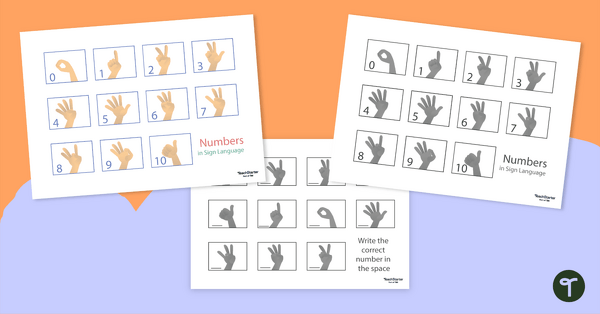
Post the numbers in American Sign Language on your classroom wall so students have an easy reference!
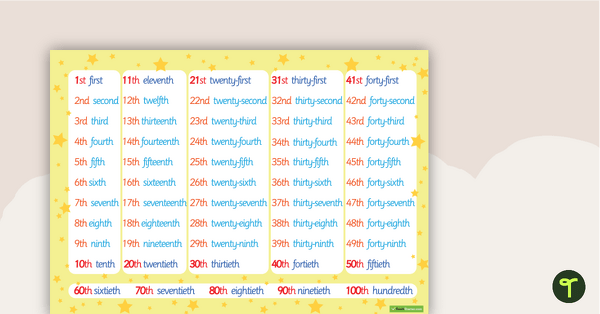
A poster for ordinal numbers 1st - 50th, plus 60th, 70th, 80th, 90th, and 100th.
0 Comments
Write a review to help other teachers and parents like yourself. If you'd like to request a change to this resource, or report an error, select the corresponding tab above.