ELAR 4.1
Developing and sustaining foundational language skills: listening, speaking, discussion, and thinking--oral language. The student develops oral language through listening, speaking, and discussion. The student is expected to:
- (1) Author's purpose and craft: listening, speaking, reading, writing, and thinking using multiple texts. The student uses critical inquiry to analyze the authors' choices and how they influence and communicate meaning within a variety of texts. The student analyzes and applies author's craft purposefully in order to develop his or her own products and performances. The student is expected to:
- (2) explain the author's purpose and message within a
text;
- (A) explain how the use of text structure contributes to the author's purpose;
- (B) analyze the author's use of print and graphic features to achieve specific purposes;
- (C) describe how the author's use of imagery, literal and figurative language such as simile and metaphor, and sound devices such as alliteration and assonance achieves specific purposes;
- (D) identify and understand the use of literary devices, including first- or third-person point of view;
- (E) discuss how the author's use of language contributes to voice; and
- (F) identify and explain the use of anecdote.
- (G) Composition: listening, speaking, reading, writing, and thinking using multiple texts--writing process. The student uses the writing process recursively to compose multiple texts that are legible and uses appropriate conventions. The student is expected to:
- (3) plan a first draft by selecting a genre for a
particular topic, purpose, and audience using a range of strategies such as
brainstorming, freewriting, and mapping;
- (A) develop drafts into a focused, structured, and coherent piece of writing by:
- (B) organizing with purposeful structure, including an
introduction, transitions, and a conclusion; and
- (i) developing an engaging idea with relevant details;
- (ii) revise drafts to improve sentence structure and word choice by adding, deleting, combining, and rearranging ideas for coherence and clarity;
- (C) edit drafts using standard English conventions, including:
- (D) complete simple and compound sentences with subject-verb
agreement and avoidance of splices, run-ons, and fragments;
- (i) past tense of irregular verbs;
- (ii) singular, plural, common, and proper nouns;
- (iii) adjectives, including their comparative and superlative forms;
- (iv) capitalization of historical periods, events, and documents; titles of books; stories and essays; and languages, races, and nationalities;
- (v) adverbs that convey frequency and adverbs that convey degree;
- (vi) prepositions and prepositional phrases;
- (vii) pronouns, including reflexive;
- (viii) coordinating conjunctions to form compound subjects, predicates, and sentences;
- (ix) punctuation marks, including apostrophes in possessives, commas in compound sentences, and quotation marks in dialogue; and
- (x) correct spelling of words with grade-appropriate orthographic patterns and rules and high-frequency words; and
- (xi) publish written work for appropriate audiences.
- (E) Composition: listening, speaking, reading, writing, and thinking using multiple texts--genres. The student uses genre characteristics and craft to compose multiple texts that are meaningful. The student is expected to:
- (4) compose literary texts such as personal narratives
and poetry using genre characteristics and craft;
- (A) compose informational texts, including brief compositions that convey information about a topic, using a clear central idea and genre characteristics and craft;
- (B) compose argumentative texts, including opinion essays, using genre characteristics and craft; and
- (C) compose correspondence that requests information.
- (D) Inquiry and research: listening, speaking, reading, writing, and thinking using multiple texts. The student engages in both short-term and sustained recursive inquiry processes for a variety of purposes. The student is expected to:
- (5) generate and clarify questions on a topic for
formal and informal inquiry;
- (A) develop and follow a research plan with adult assistance;
- (B) identify and gather relevant information from a variety of sources;
- (C) identify primary and secondary sources;
- (D) demonstrate understanding of information gathered;
- (E) recognize the difference between paraphrasing and plagiarism when using source materials;
- (F) develop a bibliography; and
- (G) use an appropriate mode of delivery, whether written, oral, or multimodal, to present results.
- (H) listen actively, ask relevant questions to clarify information, and make pertinent comments;
- (I) follow, restate, and give oral instructions that involve a series of related sequences of action;
- (J) express an opinion supported by accurate information, employing eye contact, speaking rate, volume, enunciation, and the conventions of language to communicate ideas effectively; and
- (K) work collaboratively with others to develop a plan of shared responsibilities.
- Plus Plan
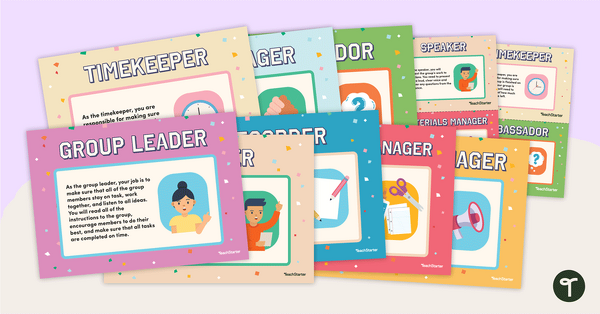
Group Work Role Cards
Review and reinforce eight possible roles for group work with this set of 2-in-1 reusable posters and desk cards.
- Plus Plan
HOT (Higher Order Thinking) Questions Wall
Higher Order Thinking signage material and page borders to use in conjunction with Bloom's Taxonomy.
- Plus Plan
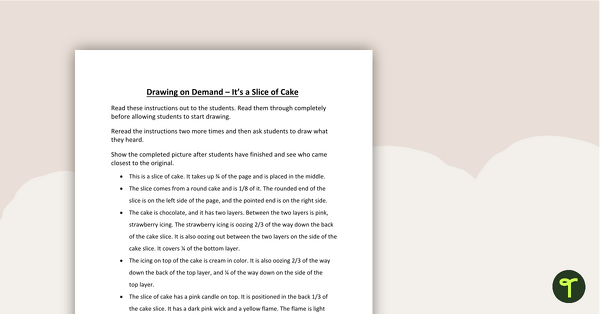
Directed Drawing - How to Draw a Piece of Cake
Use this directed drawing activity of a piece of cake to help students develop their listening skills in the classroom.
- Plus Plan
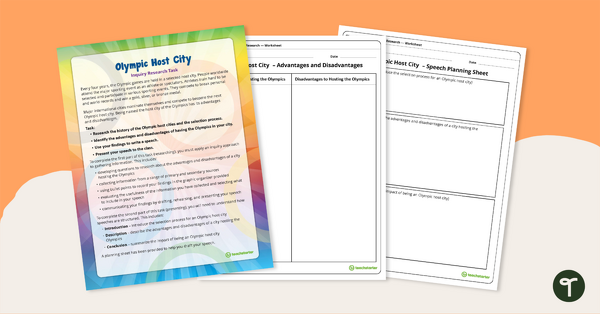
Olympic Host City Bid – Speechwriting Project
Explore the advantages and disadvantages of being the host city for the Olympics in this inquiry and speechwriting task.
- Plus Plan
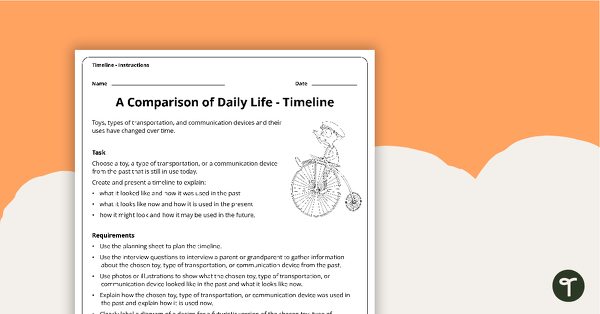
A Comparison of Daily Life - Assessment Task
An open-ended assessment task for students to demonstrate their understanding of how toys, types of transportation, and communication devices and their uses have changed over time.
- Plus Plan
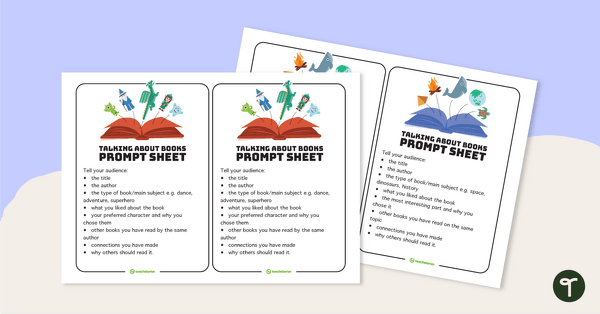
Talking About Books - Prompts
Prompts for students to use when orally discussing books.
- Plus Plan
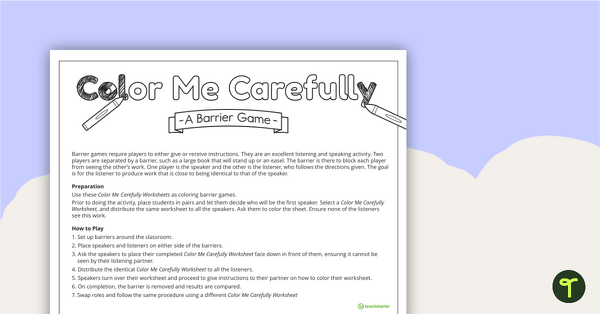
Color Me Carefully Game
Practice your students' listening and speaking skills with a fun coloring activity.
- Plus Plan
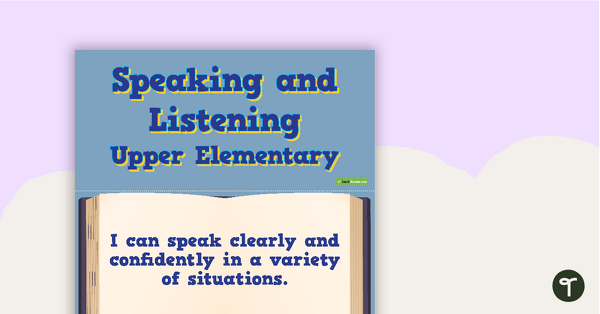
'I Can' Statements - Speaking and Listening (Upper Elementary)
A set of 11 'I can' statement cards focusing on speaking and listening for upper elementary.