Represents and compares halves, quarters, thirds and fifths as lengths on a number line and their related fractions formed by halving (eighths, sixths and tenths)
Conduct guided statistical investigations involving the collection, representation and interpretation of data for categorical and discrete numerical variables with respect to questions of interest
Acquire data for categorical and discrete numerical variables to address a question of interest or purpose by observing, collecting and accessing data sets; record the data using appropriate methods including frequency tables and spreadsheets
Recognise and use the relationship between formal units of time including days, hours, minutes and seconds to estimate and compare the duration of events
Extend and apply knowledge of addition and subtraction facts to 20 to develop efficient mental strategies for computation with larger numbers without a calculator
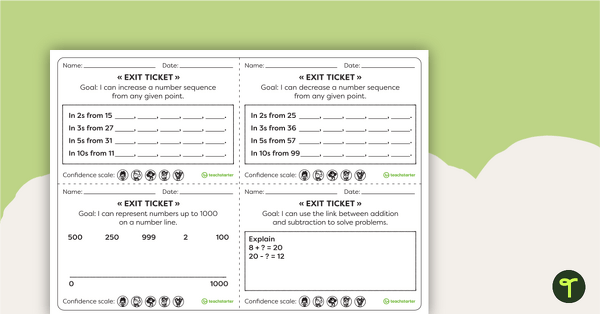
Recognise and explain the connection between addition and subtraction as inverse operations, apply to partition numbers and find unknown values in number sentences
Use mathematical modelling to solve practical problems involving additive and multiplicative situations including financial contexts; formulate problems using number sentences and choose calculation strategies, using digital tools where appropriate; interpret and communicate solutions in terms of t
Multiply and divide one- and two-digit numbers, representing problems using number sentences, diagrams and arrays, and using a variety of calculation strategies
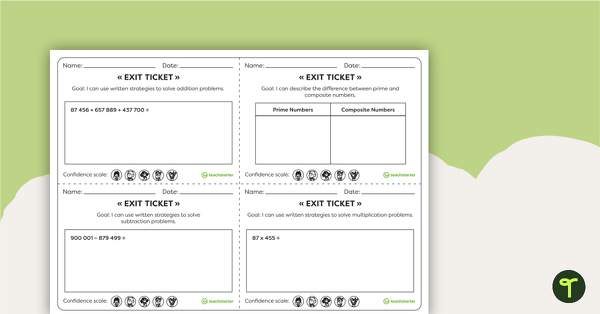
Add and subtract two- and three-digit numbers using place value to partition, rearrange and regroup numbers to assist in calculations without a calculator
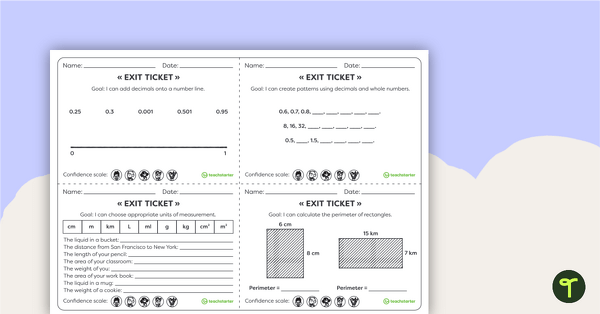
Recognise and represent unit fractions including 1/2, 1/3, 1/4, 1/5 and 1/10 and their multiples in different ways; combine fractions with the same denominator to complete the whole
Recognise, describe and create additive patterns that increase or decrease by a constant amount, using numbers, shapes and objects, and identify missing elements in the pattern
Follow and create algorithms involving a sequence of steps and decisions that use addition or multiplication to generate sets of numbers; identify and describe any emerging patterns
Conduct guided statistical investigations involving the collection, representation and interpretation of data for categorical and discrete numerical variables with respect to questions of interest
Create and compare different graphical representations of data sets, including using software where appropriate; interpret the data in terms of the context
Acquire data for categorical and discrete numerical variables to address a question of interest or purpose by observing, collecting and accessing data sets; record the data using appropriate methods, including frequency tables and spreadsheets
Recognise and use the relationship between formal units of time, including days, hours, minutes and seconds, to estimate and compare the duration of events
Extend and apply knowledge of addition and subtraction facts to 20 to develop efficient mental strategies for computation with larger numbers without a calculator
Recognise and explain the connection between addition and subtraction as inverse operations, apply to partition numbers and find unknown values in number sentences
Use mathematical modelling to solve practical problems involving additive and multiplicative situations, including financial contexts; formulate problems using number sentences and choose calculation strategies, using digital tools where appropr...
Multiply and divide one- and two-digit numbers, representing problems using number sentences, diagrams and arrays, and using a variety of calculation strategies
Add and subtract two- and three-digit numbers using place value to partition, rearrange and regroup numbers to assist in calculations without a calculator
Recognise and represent unit fractions including 1/2, 1/3, 1/4, 1/5 and 1/10 and their multiples in different ways; combine fractions with the same denominator to complete the whole
Recognise, describe and create additive patterns that increase or decrease by a constant amount, using numbers, shapes and objects, and identify missing elements in the pattern
Collect data, organise into categories and create displays using lists, tables, picture graphs and simple column graphs, with and without the use of digital technologies
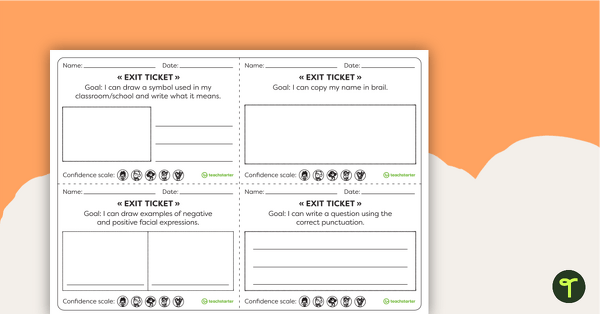
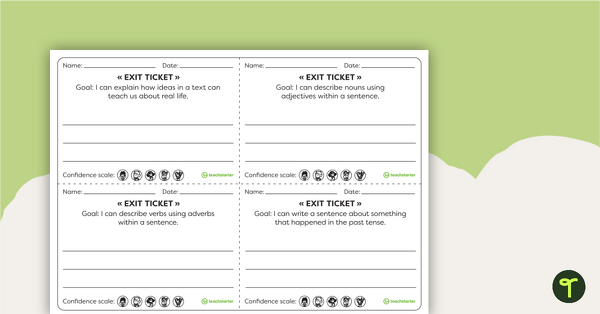
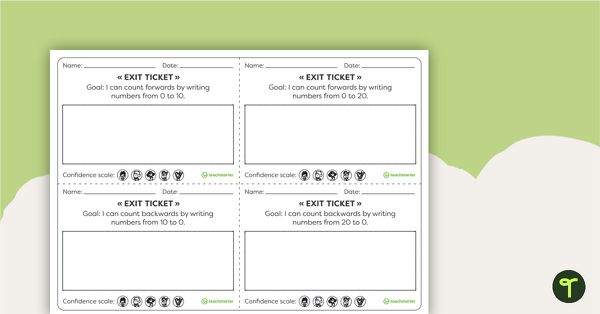
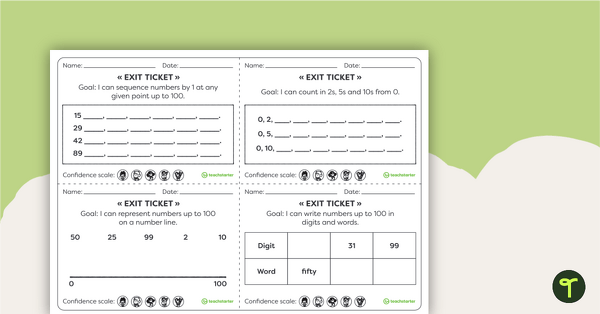
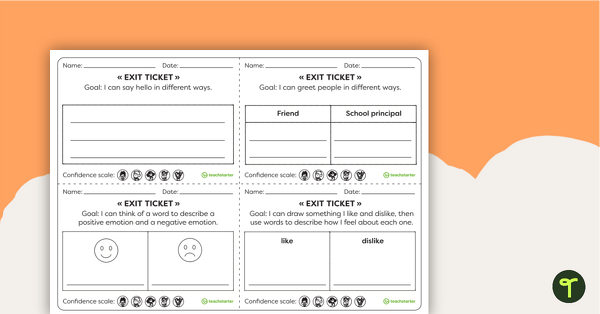
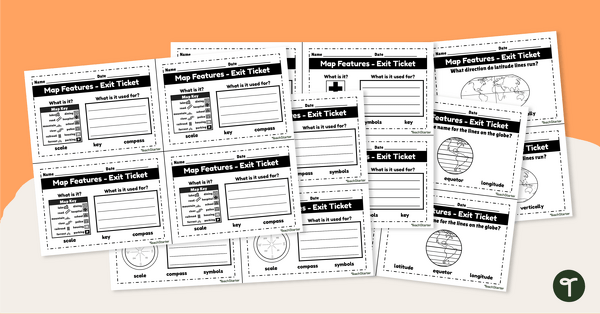
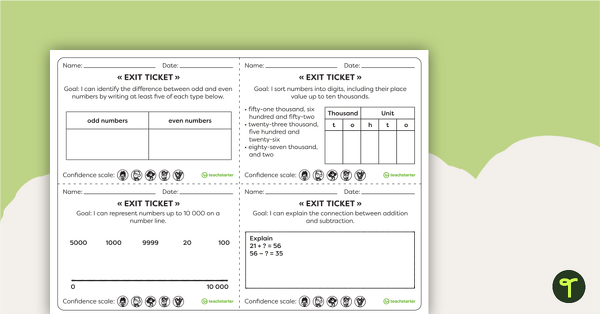
21 Numeracy Exit Ticket activities for students to provide evidence of their learning progress.
This teaching resource is an assessment tool for students to show evidence of their learning. Use Exit Tickets after a numeracy skill has been taught to show evidence that students have acquired the skill and are ready to move forward to the next learning goal.
These Numeracy Exit tickets collect evidence for basic Year 3 curriculum requirements. Use the editable Word version to create your own class-specific learning goals.
Represents and compares halves, quarters, thirds and fifths as lengths on a number line and their related fractions formed by halving (eighths, sixths and tenths)
Conduct guided statistical investigations involving the collection, representation and interpretation of data for categorical and discrete numerical variables with respect to questions of interest
Acquire data for categorical and discrete numerical variables to address a question of interest or purpose by observing, collecting and accessing data sets; record the data using appropriate methods including frequency tables and spreadsheets
Recognise and use the relationship between formal units of time including days, hours, minutes and seconds to estimate and compare the duration of events
Extend and apply knowledge of addition and subtraction facts to 20 to develop efficient mental strategies for computation with larger numbers without a calculator
Recognise and explain the connection between addition and subtraction as inverse operations, apply to partition numbers and find unknown values in number sentences
Use mathematical modelling to solve practical problems involving additive and multiplicative situations including financial contexts; formulate problems using number sentences and choose calculation strategies, using digital tools where appropriate; interpret and communicate solutions in terms of t
Multiply and divide one- and two-digit numbers, representing problems using number sentences, diagrams and arrays, and using a variety of calculation strategies
Add and subtract two- and three-digit numbers using place value to partition, rearrange and regroup numbers to assist in calculations without a calculator
Recognise and represent unit fractions including 1/2, 1/3, 1/4, 1/5 and 1/10 and their multiples in different ways; combine fractions with the same denominator to complete the whole
Recognise, describe and create additive patterns that increase or decrease by a constant amount, using numbers, shapes and objects, and identify missing elements in the pattern
Follow and create algorithms involving a sequence of steps and decisions that use addition or multiplication to generate sets of numbers; identify and describe any emerging patterns
Conduct guided statistical investigations involving the collection, representation and interpretation of data for categorical and discrete numerical variables with respect to questions of interest
Create and compare different graphical representations of data sets, including using software where appropriate; interpret the data in terms of the context
Acquire data for categorical and discrete numerical variables to address a question of interest or purpose by observing, collecting and accessing data sets; record the data using appropriate methods, including frequency tables and spreadsheets
Recognise and use the relationship between formal units of time, including days, hours, minutes and seconds, to estimate and compare the duration of events
Extend and apply knowledge of addition and subtraction facts to 20 to develop efficient mental strategies for computation with larger numbers without a calculator
Recognise and explain the connection between addition and subtraction as inverse operations, apply to partition numbers and find unknown values in number sentences
Use mathematical modelling to solve practical problems involving additive and multiplicative situations, including financial contexts; formulate problems using number sentences and choose calculation strategies, using digital tools where appropr...
Multiply and divide one- and two-digit numbers, representing problems using number sentences, diagrams and arrays, and using a variety of calculation strategies
Add and subtract two- and three-digit numbers using place value to partition, rearrange and regroup numbers to assist in calculations without a calculator
Recognise and represent unit fractions including 1/2, 1/3, 1/4, 1/5 and 1/10 and their multiples in different ways; combine fractions with the same denominator to complete the whole
Recognise, describe and create additive patterns that increase or decrease by a constant amount, using numbers, shapes and objects, and identify missing elements in the pattern
Collect data, organise into categories and create displays using lists, tables, picture graphs and simple column graphs, with and without the use of digital technologies
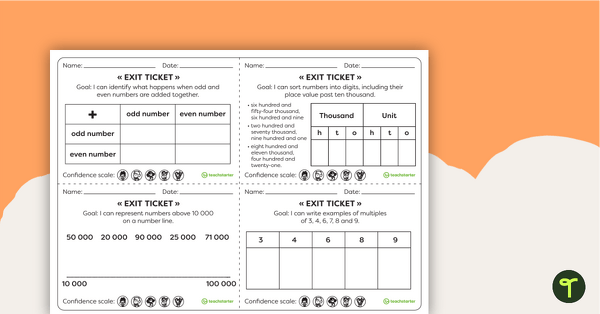
Recognise, model, represent and order numbers to at least 10 000
Teach Starter Publishing
We create premium quality, downloadable teaching resources for primary/elementary school teachers that make classrooms buzz!
2 Comments
Write a review to help other teachers and parents like yourself. If you'd like to
request a change to this resource, or report an error, select the corresponding tab
above.
There is an error in the web copy for this resource. It uses they as a pronoun without specifying a subject and needs an 'are' before ready.
'Use Exit Tickets after a numeracy skill has been taught, as a way to show evidence that STUDENTS have acquired the skill and ARE ready to move forward to the next learning goal.
Tom (Teach Starter)
·
Hi Roberta,
Thank you for letting us know! The resource description has been updated.
If we can assist with anything else, please don't hesitate to contact us.
Extra 100 in number line activity has been corrected to 1000. Information showing the relationship between addition and subtraction adjusted.
Suggest a Change
Would you like something changed or customised on this resource? While our team
makes every effort to complete change suggestions, we can't guarantee that every
change will be completed.
There is an error in the web copy for this resource. It uses they as a pronoun without specifying a subject and needs an 'are' before ready. 'Use Exit Tickets after a numeracy skill has been taught, as a way to show evidence that STUDENTS have acquired the skill and ARE ready to move forward to the next learning goal.
Hi Roberta, Thank you for letting us know! The resource description has been updated. If we can assist with anything else, please don't hesitate to contact us.